

Start with the handoffs your business must control
A parts distributor or dealer needs to control more than the storefront. The important handoffs begin when a business account identifies itself, continue through product and parts selection, and end when the buyer can understand what happened to an order and where to get help.
B2B buying journeys are generally longer and more complex than most B2C journeys, and purchases often involve larger buying teams. B2B products and larger orders can also require documentation and several support options. That context changes how you should assess an ecommerce platform: a polished product page is only one point in a chain of account, catalog, transaction, fulfillment, and support information.
Start by naming the handoffs that cause work or uncertainty today:
- Account identity to account-specific catalog, pricing, payment terms, or purchasing permissions.
- Product and equipment information to a distinguishable part or compatible option.
- Quote, order, or repeat purchase to the correct commercial and fulfillment process.
- Order activity to status, shipment, invoice, or support information.
- Customer question to the right document, request path, or service team.
A B2B ecommerce platform can connect a storefront with ERP, CRM, inventory, payment, order, and fulfillment systems while supporting account-specific pricing, catalogs, payment terms, procurement, and fulfillment. That possibility is a starting point, not a finished operating model.
The fit question is therefore practical: can the platform preserve the context your team needs at each handoff, and can your organization supply, govern, and support the information behind it? The sections below turn that question into an evaluation path.
Define the platform in distributor terms
A B2B ecommerce platform is a digital purchasing layer that lets business customers access relevant products, account information, commercial terms, orders, and support processes through a connected online experience. For a parts distributor or dealer, that usually means more than publishing a catalog and adding a checkout button.
B2B commerce can include manufacturers selling to distributors and distributors supplying parts, materials, or products directly to business customers. A B2B customer portal can provide secure self-service access to account information, reorders, documents, requests, and purchases.
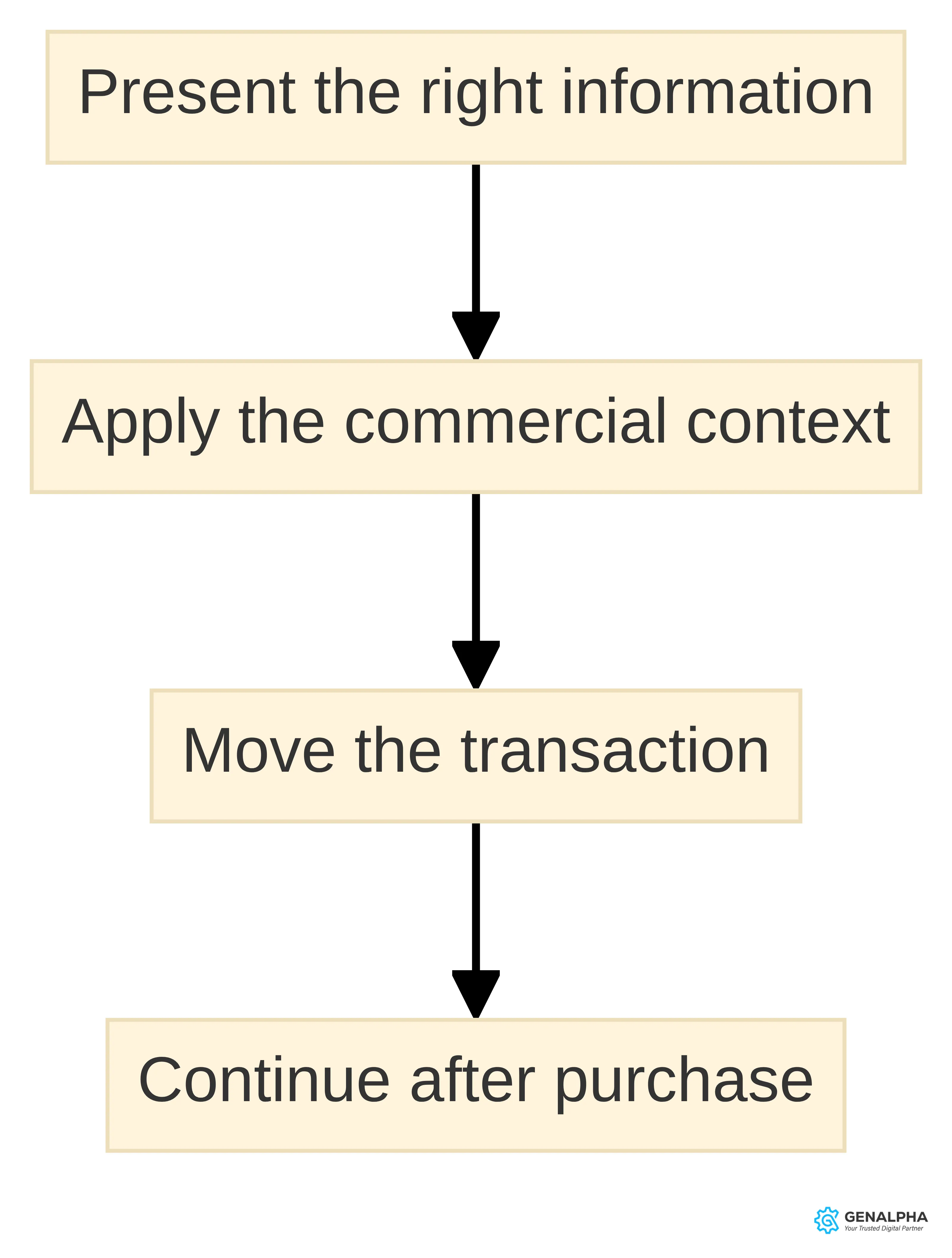
Use that definition to separate four jobs that are often bundled together:
- Present the right information. Product records, parts details, documents, and compatibility guidance need to be understandable in the context of the equipment or account.
- Apply the commercial context. The experience may need account-specific catalogs, pricing, payment terms, procurement rules, or approval paths.
- Move the transaction. A selected part or equipment item must enter an order, quote, recurring purchase, or fulfillment workflow that the business can operate.
- Continue after purchase. The customer may need reordering, shipment tracking, invoice access, documents, or a route for requests and support.
The platform is the technology used to coordinate these jobs. It is not automatically the source of every product record, price, inventory position, invoice, or service answer. Those may come from connected systems, maintained data, or operating teams. Ecommerce integration can connect storefronts with ERP, CRM, inventory, payment, order, and fulfillment systems, but the quality of the result depends on the information and rules moving between them.
Define your evaluation in the same terms. Instead of asking whether a platform has a product page, ask whether it can preserve account, product, transaction, and support context across the complete path you need to operate.
Map the buyer and account context first
A parts distributor or dealer should map account context before comparing storefront features. Business purchasing rarely follows a single anonymous path: the same product may carry different terms, permissions, documents, or fulfillment expectations depending on the account and the person acting for it.
Distributor buyers may want to reorder, track shipments, manage contacts, and access invoices through self-service capabilities. A B2B customer portal can also provide secure access to account-specific information, documents, requests, and purchases.
Write down the account situations your platform must recognize:
- A dealer buying under an established account with negotiated pricing.
- Several contacts sharing one account while holding different responsibilities.
- A buyer repeating a prior order without rebuilding the product search.
- A customer needing an invoice, shipment update, or account document after ordering.
- A business buyer moving from a request or quote into an order.
- A customer who needs assistance because the part or commercial path is unclear.
Then ask which system owns each piece of context. Ecommerce integration can support account-specific pricing, catalogs, payment terms, procurement, and fulfillment, but your evaluation should identify the system of record, the synchronization need, and the responsibility for resolving conflicts.
Your account map should also distinguish access from authorization. A person may be able to sign in without having permission to view every price, place every order, approve a purchase, or manage every contact. Do not treat a login screen as proof that the account model is handled.
A useful evaluation question is: “Show how this account’s identity, terms, contacts, order history, invoices, and permissions travel through a repeat purchase.” Ask for the same scenario with a new contact, a changed term, and an exception. The answer should make clear which behavior belongs to the platform, which comes from an integrated system, and which still requires staff involvement.
Account fit is established when the experience reflects how your customers buy, not merely when it allows them to create an account.
Treat parts data and compatibility as a prerequisite
Parts data determines whether an online purchasing path can answer the first question: “Which part applies to this equipment, application, or account?” A platform cannot resolve unclear identification by itself. Your catalog, equipment relationships, part numbers, descriptions, documents, and compatibility rules must be organized well enough for the experience to present a useful choice.
In complex ecommerce, fitment and compatibility guidance should work alongside product data, catalog enrichment, merchandising, product search, and support rather than operate as an isolated layer.
Assess the information foundation in this order:
- Identity. Can you distinguish the equipment, model, serial range, configuration, or other context that determines a part choice?
- Part definition. Does each sellable part have a usable identifier, description, status, unit information, and relevant documentation?
- Relationship. Can the experience show which equipment or application a part fits, and under what conditions?
- Commercial connection. Can the selected part move into the applicable price, availability, quote, order, and fulfillment path?
- Support connection. Can you direct an unresolved identification question to the right document, request, or team?
A managed SaaS storefront may suit a business that can work within the provider’s supported commercial and catalog models, but fitment extensions, external data services, integration limits, and responsibility across apps still require evaluation.
Data conversion is a separate delivery consideration. Our data conversion service helps organize parts data for ecommerce sales channels. That service describes what we offer; it does not remove your responsibility to decide which relationships, fields, documents, and exceptions the business needs to maintain.
Ask a platform team to demonstrate one difficult identification path rather than only a clean search. Give it a known equipment context, an ambiguous description, a superseded part, and a part that requires supporting information. Then ask where the data came from, who maintains it, how changes reach the experience, and what happens when no confident match is available.
The practical boundary is clear: platform search and compatibility features can expose organized information, but they cannot substitute for accurate, governed parts data. Treat data readiness as a prerequisite and a continuing operating responsibility.
Trace the commercial transaction beyond the product page
A product page is only useful when the selected item can enter the right commercial process. Parts distributors and dealers should trace the transaction from account recognition through price, availability, quote, order, payment, procurement, and fulfillment rather than evaluating each screen in isolation.
B2B ecommerce integration can support account-specific pricing, catalogs, payment terms, procurement, and fulfillment while connecting the storefront with ERP, CRM, inventory, payment, order, and fulfillment systems.
Build a transaction trace with these checkpoints:
- Account and terms: Which customer account is active, and which catalog, price, payment terms, or purchasing rules apply?
- Product and quantity: Is the selected part the correct item, and can the buyer choose the required quantity or unit of measure?
- Availability: Where does availability come from, how is it represented, and what condition applies when the value is unknown or changing?
- Quote or order: Does the buyer need an approved quote, negotiated price, purchase order, credit check, or direct order path?
- Payment and procurement: Which payment or procurement process applies to this account and transaction?
- Fulfillment: Which system receives the order, and how are exceptions, substitutions, backorders, or split shipments handled?
If your distributor business sells on negotiated terms, evaluate whether quoting or CPQ-adjacent workflows connect directly to ordering. A quote that must be re-entered manually can create a break between the agreed commercial context and the submitted order.
A platform that supports subscriptions alongside standard ecommerce orders can avoid managing recurring orders, maintenance entitlements, and service agreements in separate systems. This matters only if those transaction types belong to your operating model, so include them in the evaluation when your business actually sells through those arrangements.
Ask for a walkthrough using one ordinary reorder and one exception. The walkthrough should show where price and availability originate, how a negotiated term enters the order, what the buyer sees when the value is unavailable, and which team owns the resulting exception. A convincing interface is not enough if the commercial context disappears at the handoff.
Follow the order into visibility and support
Order completion is not the end of the customer journey. A parts distributor or dealer should evaluate what the customer can understand after submission: whether the order was accepted, where it stands, what was shipped, which invoice applies, and how to ask for help.
Distributor buyers may want self-service capabilities for reordering, shipment tracking, contact management, and invoice access. B2B products and larger orders can require documentation, chatbots, and continuously available customer-service teams.
Use a post-order checklist:
- Can the customer find the submitted order and its current status?
- Can the customer distinguish an accepted order from a pending, backordered, split, or exception state?
- Can the customer connect shipment information and invoice history to the correct order?
- Can an authorized contact reorder from a prior transaction without losing account context?
- Can the customer find the document or support path needed for a product or service question?
- Can staff see enough context to answer a request without asking the customer to repeat the entire transaction?
Humphrey Service Parts aims to offer visibility into order status, shipment tracking, and invoice history through its new ecommerce platform. The stated aim is not evidence that every organization will receive the same result; it is a useful example of the post-order visibility to test in your own requirements.
Trace one order after submission and deliberately introduce a change. Ask what the customer sees when a shipment is partial, an invoice is issued separately, or an order needs staff attention. Then ask how the support team receives the same context. Your fit assessment should record the boundary between self-service information and human assistance, not assume that every exception belongs online.
Separate platform capability from delivery responsibility
A platform feature list describes what a product can support. It does not tell you who will prepare data, design integrations, test commercial rules, govern permissions, maintain content, or handle exceptions after launch. Separate those responsibilities before comparing options.
Integration complexity can be affected by data quality, legacy systems, security, scalability, testing, data volumes, synchronization needs, and custom development. Integration costs and timelines depend on architecture, system complexity, data requirements, and custom development.
Create a responsibility map with one row for each required capability:
- Capability: What must the customer or staff member be able to do?
- Information: Which product, account, order, price, inventory, invoice, or support data is required?
- System owner: Which existing or new system owns that information?
- Integration path: How does the information enter, change, and leave the platform?
- Business owner: Who approves the rule, content, or exception?
- Test condition: What ordinary case and failure case must pass before release?
- Operating duty: Who monitors changes, resolves errors, and updates the experience?
A managed service may place more storefront operations within the provider’s supported model, while a composable approach may leave more architecture and coordination with your organization. Neither label answers how your particular data and commercial rules will be handled. The answer belongs in the responsibility map.
An ecommerce RFP can involve ecommerce, IT and architecture, pricing or commercial, finance or accounts receivable, procurement, legal, security, and marketing stakeholders. Bring those perspectives into the map early so the buying team does not assess only the customer-facing interface.
Ask every platform option to identify the work that remains with your organization. Include data preparation, integration design, testing, content maintenance, access administration, reporting, exception handling, security review, and ongoing support. A platform fits your operating capacity only when the required ownership is explicit and available.
Compare operating approaches by control and capacity
This section contrasts two operating approaches: a managed SaaS storefront and a composable B2B implementation. The useful comparison is not a general ranking. It is the relationship between the control you need and the capacity you can sustain.
The following table uses shared criteria to frame the discussion:
| Criterion | Managed SaaS storefront | Composable B2B implementation |
|---|---|---|
| Starting condition | Your business can work within the provider’s supported commercial and catalog models. | Existing systems, complex agreements, or several channels require more architectural control. |
| What to examine | Fitment extensions, external data services, integration limits, and responsibility across apps. | Data modeling, integration delivery, coordinated support, testing, and ongoing engineering capacity. |
| Main operating question | Can the supported model represent your accounts, parts, transactions, and support path? | Can your organization assemble and operate the connected services over time? |
| Decision boundary | A supported storefront model may not cover every external data or integration requirement. | More control brings more ownership of the assembled environment. |
A composable B2B implementation can provide more architectural control for businesses with existing systems, complex agreements, or multiple channels, but it requires ownership of data modeling, integration delivery, coordinated support, testing, and ongoing engineering capacity.
Use the table as a conversation starter, not as a decision by itself. List the account rules, parts relationships, quote paths, order states, support needs, and integrations that your business cannot compromise. Then match each item to the approach’s supported model and your team’s available ownership.
The clearest boundary is capacity. More control has to be paired with the people, processes, testing, and ongoing engineering work needed to use that control. Compare the responsibility you can operate, not only the architecture you prefer.
Build comparison questions around evidence, not claims
A useful platform comparison asks for a visible answer to a defined business scenario. Broad promises about flexibility or self-service do not show how your account, parts, commercial, order, and support handoffs will work.
Prepare a short scenario set before you speak with a provider:
- Account scenario: A dealer contact signs in, sees account-specific terms, and needs to reorder a known part.
- Identification scenario: A customer starts with equipment context and needs guidance to a distinguishable part.
- Commercial scenario: A negotiated price or quote must become an order without losing the agreed context.
- Exception scenario: Availability changes, an order splits, or a transaction needs staff intervention.
- Post-order scenario: The customer needs status, shipment, invoice, or a support path after submission.
- Data scenario: A product, compatibility relationship, document, or price changes and must reach the right experience.
For each scenario, ask these questions:
- What does the customer see at each step?
- Which system supplies the information?
- What happens when the information is missing, delayed, or contradictory?
- Which account roles can view, change, approve, or submit the action?
- What does staff receive when the customer needs help?
- Which part of the workflow is standard, configurable, custom, or outside the platform?
- Who tests and maintains the connection after it goes live?
Give each group questions that match its responsibility instead of asking one team to judge every dimension.
Ask for prebuilt ERP connectors and whether the platform includes an integrated iPaaS layer when enterprise integration is part of your requirements. Also ask how the option handles data quality, legacy systems, security, scalability, testing, synchronization needs, and custom development.
Record the answer as a condition and an owner. “Supported” should mean that you know which data, configuration, integration, responsibility, and exception path make the scenario work. That record gives your team a more useful comparison than feature count alone.
Turn each scenario into a bounded fit record rather than a general impression. Note the account type, equipment or part context, commercial condition, required post-order visibility, and exception to be tested. Then classify what the session establishes:
- shown in the configured workflow;
- supported through an identified integration;
- dependent on custom development or an external data service;
- still staff-assisted; or
- unresolved because the needed behavior was not shown.
These labels describe what your team observed in that scenario, not a ranking of platform quality. Keep the scenario, data source, system owner, and open question beside each label.
Use a separate line for each important handoff. For the account line, note the identity, terms, contacts, permissions, and approval behavior that were demonstrated. For the parts line, note the equipment context, part relationship, documentation, and result when no confident match is available. For the transaction line, note where price, availability, quote, order, payment, and fulfillment information originated. For the post-order line, note how status, shipment, invoice, and support information remained connected. This keeps a screen-level demonstration from standing in for the complete path.
Treat an unanswered question as a condition to resolve, not as an implied capability. An account-specific price may appear on screen while its source, update path, or exception owner remains unclear. A parts search may return a result while the relationship maintenance and supporting documents remain unassigned. An order-status view may be visible while shipment or invoice linkage has not been established. In each case, record the visible behavior separately from the data, integration, and operating work needed to sustain it.
Before comparing options, group open conditions under four headings: data, integration, ownership, and capacity. Data includes fields, relationships, documents, and quality. Integration includes system connections, synchronization needs, and testing. Ownership includes rule approval, content maintenance, access administration, and exception handling. Capacity includes the people and ongoing engineering or support work needed after launch. These headings do not replace a technical or commercial review; they make the remaining work visible to the people who must assess it.
At the end of each session, write a conditional conclusion for every scenario: the demonstrated path can be assessed against current operations; the path depends on named data or integration work; or the decision remains open because a required step was not shown. Carry the open conditions into the next conversation and ask which party owns each one. This produces a comparison based on the account, parts, transaction, support, and delivery paths that matter to the business, rather than on the number of features presented.
Use first-party examples as workflow illustrations
First-party examples can help you turn abstract requirements into concrete questions, but each example should stay within its stated scope. That makes data preparation a useful topic for evaluation, not a reason to assume that your catalog is ready.
Equip360 is designed specifically for parts dealers and manufacturers. Equip360 includes tools that make it easier for customers to find and purchase parts and equipment online. Use those statements to ask how your own equipment context, parts relationships, account rules, and purchase paths would be represented.
The customer examples also suggest specific workflow questions:
- M-B Companies implemented our Equip360 interactive parts manuals to improve customer satisfaction and support. Ask how an interactive manual would connect to your parts data, identification path, documents, and support process.
- Alamo Group partnered with us to implement Equip360 as a centralized dealer platform. Ask which dealer roles, account context, order paths, and system handoffs a centralized platform would need to support in your organization.
- Humphrey Service Parts aims to provide visibility into order status, shipment tracking, and invoice history through its new ecommerce platform. Ask how your order states, shipment information, and invoices would be connected and presented.
- Humphrey Service Parts aims to let customers place orders online and reduce dependence on phone and email support for routine transactions. Ask which routine transactions you would move online and which exceptions would remain staff-assisted.
These examples illustrate workflows and stated aims; they do not establish a universal result or remove the need to examine your data, integrations, commercial rules, and operating capacity. Use each example to create a scenario that your team can discuss and test.
Turn the evaluation into a controlled next action
A suitable platform should preserve the context your business needs from account recognition through parts identification, commercial transaction, order visibility, and support. Before moving forward, put one real scenario on paper and answer five questions:
- Can the account and its purchasing context be represented?
- Can the product and part information support the required identification path?
- Can price, availability, quote, order, payment, and fulfillment handoffs remain connected?
- Can the customer and staff see the right post-order information?
- Can your organization own the data, integrations, testing, exceptions, and ongoing operations?
A platform decision still belongs with your technical, commercial, finance, security, procurement, and operational teams because suitability depends on your systems, data, agreements, and capacity. An ecommerce RFP can involve those stakeholder groups, while integration complexity depends on architecture, system complexity, data requirements, and custom development.
If the scenario exposes a specific account, parts, transaction, or support question, carry that scenario into a focused platform conversation. Use the result to distinguish supported capability from required integration and from work your organization must own.
Sources
- What Is B2B Ecommerce? Benefits, Trends, and Best Practices — www.liferay.com
- B2B eCommerce for Distributors: Platform Guide — www.elasticpath.com
- B2B Ecommerce Integration For Enterprises | RBMSoft — rbmsoft.com, 2026-10-13
- The definitive guide to B2B ecommerce — business.adobe.com
- AI Fitment and Compatibility Guidance for Complex eCommerce | Web Shop Manager — webshopmanager.com
- Automotive Ecommerce: Why Parts Data Wins in B2B — virtocommerce.com, 2026-09-23
- M-B Customer Success Story | GenAlpha
- Alamo Group Case Study | GenAlpha
- Humphrey Customer Success Story | GenAlpha
- Request a Demo of Equip360 | GenAlpha Technologies