

The decision is about operating responsibility, not just where the storefront runs
A cloud-based eCommerce decision is a decision about who operates which parts of your commerce environment. The storefront is only the visible layer. Behind it sit product and parts data, customer access, pricing, inventory information, ordering, integrations, security tasks, backups, upgrades, and the people responsible for resolving exceptions.
A cloud operating model can reduce infrastructure and operational responsibilities while supporting flexibility, customization, and scalability. It does not remove every responsibility from your organization. The practical question is not whether cloud sounds modern. The practical question is whether the responsibility boundary fits the way your equipment business sells, supports, and updates products.
Equipment manufacturers need a fit test that follows a transaction from product definition to purchase and support. A platform may look suitable in a demonstration yet leave unclear ownership for data preparation, account rules, integration changes, security settings, or service documentation.
Use this guide to work through four questions:
- What does cloud-based commerce actually change?
- Which responsibilities move to a provider, and which remain with you?
- Can the operating model support complex equipment and aftermarket-parts work?
- What evidence should you require before moving from interest to technical review?
A vendor evaluation becomes more useful when each desired outcome has a score, an owner, an evidence type, and a verification method. That approach gives your team a way to compare platforms without treating a general cloud label as proof of fit.
What a cloud-based eCommerce platform means
A cloud-based eCommerce platform is an online commerce application operated through cloud infrastructure rather than installed and maintained entirely on equipment owned by your organization. The phrase describes an operating arrangement, not a complete feature list. Product catalogs, parts structures, customer accounts, ordering workflows, and service content still need to be designed, supplied, governed, and connected to the systems that your business uses.
In many SaaS eCommerce arrangements, the provider handles hosting, software maintenance, upgrades, backups, and related operational work. SaaS is commonly subscription-based, but exact pricing and service responsibilities vary by vendor. The contract, service description, architecture, and support model define the arrangement more precisely than the word cloud does.
SaaS eCommerce also commonly means that new software features are released by the provider and made available as they are rolled out. That can reduce the need for your team to plan every platform update as a separate software installation. It also means your organization needs a way to assess changes, test connected workflows, and decide how new behavior affects customers, dealers, sales teams, and service operations.
The operating model therefore has two sides:
- The provider may take on more infrastructure and platform operations.
- Your organization still owns the business decisions, information quality, access rules, integration requirements, and acceptance criteria that make the commerce experience usable.
A cloud platform is a fit only when both sides are clear.
Cloud commerce should not be treated as a promise that every technical task disappears. A shared-responsibility model can reduce your infrastructure workload while leaving customer-side responsibilities for configuration, data, permissions, integrations, governance, and business operations. Those responsibilities differ by service abstraction and vendor arrangement.
Define the model in operational language. Ask who owns each activity, what access your team has, what evidence the provider supplies, how changes are tested, and what happens when an integration or data process fails. Those answers matter more than a broad claim that the platform is hosted in the cloud.
Cloud, hosted, and on-premise are different responsibility arrangements
Cloud, hosted, and on-premise labels describe different responsibility arrangements, but vendors may use the terms differently. Your comparison should therefore focus on ownership rather than the label. Ask who provides the infrastructure, who maintains the application, who controls upgrades, who manages data and permissions, and who handles recovery work.
The following table is a starting framework for your questions, not a substitute for a vendor's current architecture and contract.
| Arrangement | Infrastructure and hosting | Application maintenance | Customer-side responsibilities to test |
|---|---|---|---|
| On-premise | Your organization commonly provides and operates the environment | Your organization commonly schedules and performs application maintenance | Hardware, operating system, application changes, data, access, integrations, backups, and recovery ownership |
| Hosted | A provider may operate the environment for your organization | Responsibility may be divided between the provider, your team, and the software owner | Contract boundaries for configuration, upgrades, data, permissions, integrations, backups, and recovery |
| Cloud or SaaS | The provider commonly operates more of the underlying infrastructure | The provider commonly handles hosting, maintenance, upgrades, and related operations in a SaaS arrangement | Data, encryption choices, permissions, business configuration, integrations, governance, testing, and acceptance |
The hosted row requires particular care because hosting alone does not tell you who maintains the application. The cloud or SaaS row also requires care because the provider's scope depends on the service and agreement. Use the arrangement as a starting hypothesis, then replace it with named owners and documented boundaries.
A useful comparison keeps the same criteria across every option. Score each arrangement against the work your equipment business must perform, then record the evidence that supports each score. Include the person accountable for the decision and the method you will use to verify it.
For example, compare each option on:
- Who prepares and governs product and parts information?
- Who changes price, inventory, account, and ordering rules?
- Who tests integrations after a platform change?
- Who controls user permissions and reviews access?
- Who tests backup and restore procedures?
- Who handles an incident involving a connected system?
- Who provides evidence that the agreed service is operating as described?
The arrangement that leaves the fewest unanswered ownership questions is easier to evaluate, even if it is not the arrangement with the shortest label.
What the cloud model can simplify—and what it cannot remove
The cloud model can simplify infrastructure operations when the provider takes responsibility for hosting, maintenance, upgrades, backups, and related platform work. That shift can give your technical team fewer infrastructure tasks to perform directly and can support a more flexible, customizable, and scalable commerce arrangement.
The practical benefit is a change in work allocation. Your organization may spend less time operating the platform layer and more time defining commerce behavior, preparing information, managing customer and dealer access, testing connected systems, and reviewing changes. Those activities still require owners and time.
The cloud model cannot remove responsibility for your data, asset classification, encryption choices, permissions, business configuration, or integration decisions. In AWS's shared-responsibility model, customer duties vary by service. EC2 customers manage the guest operating system, updates and security patches, installed applications, and security-group configuration; for more abstracted services such as S3 and DynamoDB, AWS operates the infrastructure, operating system, and platform while customers manage their data, encryption choices, asset classification, and IAM permissions.
Those examples show why the service abstraction matters. A cloud contract may cover one layer while leaving another layer with you. Do not transfer a responsibility from your internal team to a provider in your planning documents until the provider's service scope and agreement support that transfer.
Cloud commerce also creates trade-offs that belong in the decision record:
- Less infrastructure work can mean more dependence on provider processes. You need a clear way to understand changes, incidents, support escalation, and service boundaries.
- Regular releases can reduce manual upgrade work while creating testing work. Your team needs a process for assessing changes against product data, parts ordering, customer access, integrations, and service content.
- Provider-managed infrastructure does not settle business ownership. Your organization still decides which customers can see which information, how account rules work, and what an acceptable transaction looks like.
The right question is not whether the cloud model has trade-offs. Every operating model does. The question is whether you can assign, monitor, and accept the trade-offs that affect your commerce work.
Responsibility changes with the service abstraction
Service abstraction determines how much of the technical stack a provider operates and how much remains with your team. An infrastructure-oriented service can leave you responsible for operating-system updates, installed applications, and network security configuration. A more abstracted service can shift infrastructure, operating-system, and platform operations to the provider while leaving your data, encryption choices, asset classification, and permissions with you.
The same word, cloud, can therefore describe materially different work for your organization. A useful review starts by identifying the actual services involved rather than assuming that one responsibility model covers the entire commerce environment.
Your responsibility map should answer these questions for each platform layer:
- Which infrastructure components does the provider operate?
- Which operating-system and application updates are included?
- Which settings must your team configure and maintain?
- Who manages customer data, encryption choices, data classification, and permissions?
- Who defines and tests firewall, web-application, backup, and recovery controls?
- Which activities are covered by the platform service, and which depend on another provider or your own team?
- What current documentation shows the boundary, and how will you review it when the service changes?
A vendor's shared-responsibility documentation can identify activities such as infrastructure security, patches, backup testing, firewall configuration, disaster-recovery planning, and operating-system hardening within the vendor's stated scope. Treat that description as a boundary to examine, not as evidence that every part of your commerce operation is covered.
Turn each responsibility into a scored evaluation criterion with an owner, evidence type, and verification method. For example, if recovery testing matters to your business, name the person who will review the evidence, specify what record is acceptable, and define how your team will test the result. That process keeps technical assumptions from becoming unowned risks.
Apply the operating model to equipment-commerce work
Equipment-commerce work puts pressure on the operating model because a purchase often depends on more than a product name and a checkout form. Your evaluation should follow the information and decisions required to identify the right item, show the right commercial terms, complete the order, and support the customer afterward.
Begin with the business situations that the platform must support. Include new equipment, replacement parts, dealer-assisted purchasing, repeat orders, account-specific access, service inquiries, and exceptions that require human involvement. The list does not need to cover every possible transaction at first. It needs to represent the work that determines whether the platform fits your operation.
Evaluate the operating model against these areas:
- Product and parts data: Can your team establish the product relationships, parts structures, descriptions, images, technical references, and revisions needed for a transaction? Identify who supplies, transforms, approves, and changes each data set.
- Customer and dealer access: Can you define account roles, visibility rules, approval paths, and assisted-service boundaries? Ask who configures access and who reviews it over time.
- Ordering: Can the platform represent the steps your customers and dealers actually follow, including identification, selection, pricing, payment, order confirmation, and exception handling? Write the acceptance conditions before the demonstration.
- Inventory and pricing visibility: Can the experience present the information your business is willing to expose, with the appropriate account or transaction rules? Ask which system is authoritative and how updates reach the commerce experience.
- Integrations: Can your team identify the systems that exchange product, parts, customer, price, inventory, order, and status information? Assign ownership for interface changes, testing, monitoring, and error handling.
- Service documentation: Can customers and service teams reach the documentation needed after purchase? Treat manuals, diagrams, parts references, warranty information, and support instructions as information requirements to validate rather than assumed platform capabilities.
- Ongoing management: Can your organization maintain information, permissions, rules, content, and connected workflows after launch? Record the internal roles and provider services required for that work.
These areas are evaluation criteria. They are not proof that any particular platform supports them.
A cloud operating model may fit an equipment business when reducing infrastructure responsibility is useful and your organization can still own the business information, integration decisions, permissions, testing, and governance that remain. A platform may require more investigation when the provider's boundaries are unclear, the data foundation is not prepared, or the transaction depends on rules that the demonstration has not tested.
Make the decision around work, not feature names. A catalog feature is relevant only when it supports the product and parts information your teams must maintain. An account feature is relevant only when it represents the access rules your channels require. An integration statement is relevant only when it identifies the systems, data flows, change process, and verification method involved.
Follow information from product definition to purchase and support
An equipment-commerce evaluation should follow information through the complete journey rather than stopping at the storefront. Product definition establishes what the item is. Parts structure connects components and references. Customer and dealer access determines who can see or act on the information. Pricing and inventory rules shape the offer. Ordering records the transaction. Service documentation supports the work that follows.
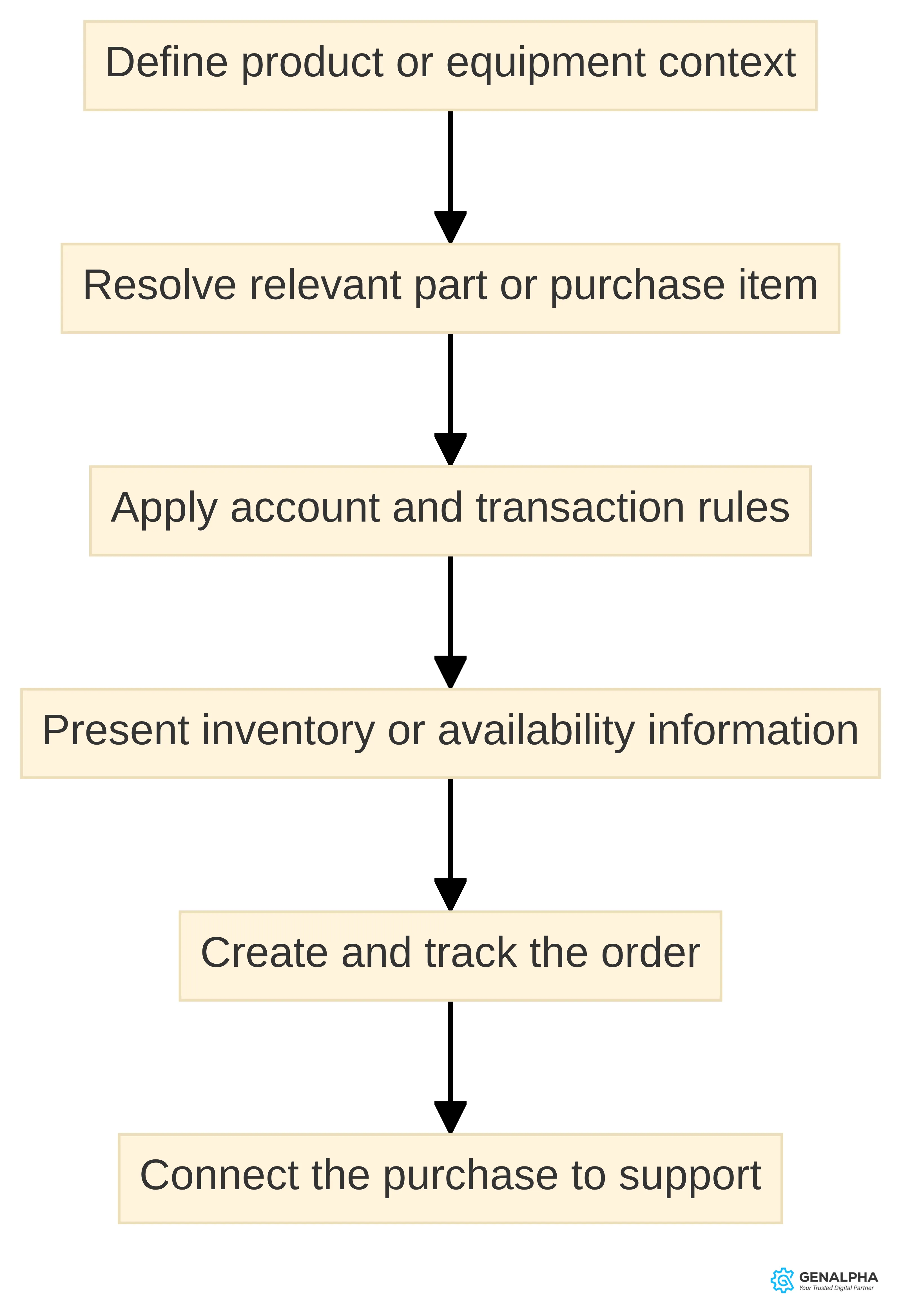
Write the journey as a sequence your team can inspect:
- Define the product or equipment context. Identify the model, configuration, serial or other distinguishing information your business uses, and the content needed to understand the item.
- Resolve the relevant part or purchase item. Record how a customer or dealer finds the item and how the system distinguishes related or substitute items.
- Apply the account and transaction rules. Identify customer-specific access, pricing, approval, tax, payment, or channel conditions that require a system decision.
- Present inventory or availability information. Name the source system, update expectation, and boundary for what the customer can rely on.
- Create and track the order. Define what confirmation means, where the order is recorded, and how exceptions reach a person or team.
- Connect the purchase to support. Identify the documentation, parts references, warranty information, and service interactions that may follow the transaction.
This sequence gives your team a shared object for comparing platforms. It also reveals where the cloud platform ends and another system, process, or team begins.
For each step, record four things: the required information, the responsible system, the accountable owner, and the evidence that proves the step works. Add the risk and cost drivers that could affect the result, such as data preparation, integration changes, adoption, security work, support tiers, or consumption conditions.
Use current-stack baselines where they exist. A baseline does not predict a future result, but it gives your team a like-for-like reference for comparing alternatives and identifying which changes need validation. Keep the baseline specific: name the workflow, the current handoff, the information source, and the way you will inspect the result.
Service documentation deserves its own checkpoint because it can sit outside the commerce platform's primary buying flow. Ask whether the platform stores, links, displays, or passes through the documentation your teams need, and ask which system remains authoritative. Do not treat the presence of an interactive page as proof that the underlying technical content, revision process, access rules, or support workflow is covered.
The same boundary applies to serial-number-specific or configuration-specific information. If your transaction depends on a particular equipment identity, write down where that identity comes from, how it is matched, who can correct it, and what the customer sees when the match is uncertain. Make the platform prove the workflow with representative information.
Use a responsibility map to compare platforms
A responsibility map assigns every important activity to your organization, the platform provider, another system owner, or a shared process. The map should name the activity and the accountable party instead of using broad labels such as handled by the cloud.
Create entries for:
- Product and parts data intake, transformation, approval, revision, and publication.
- Customer, dealer, and internal-user access creation, change, review, and removal.
- Catalog, parts structure, service documentation, and content governance.
- Price, inventory, account, payment, and order information exchange.
- Integration design, interface monitoring, error handling, and change testing.
- Platform configuration, release assessment, acceptance testing, and user communication.
- Data protection choices, permissions, asset classification, and access evidence.
- Backup, restore, disaster-recovery planning, incident response, and escalation.
- Performance or service commitments, support response, and commercial review.
The map is useful only when someone owns each entry and knows how to verify it.
Score the map against the outcomes your business actually needs. Each score should include an evidence type and verification method. Acceptable evidence might include a current architecture description, a configured demonstration, a test result, a support procedure, a service commitment, a responsibility matrix, or a review of the relevant agreement.
Keep three fields separate:
- Capability: what the platform or service is designed to do.
- Responsibility: who configures, operates, maintains, reviews, or corrects it.
- Proof: what you will inspect before accepting the claim.
A platform can have a capability while leaving configuration or data preparation with you. A provider can accept an operational task while leaving the business outcome dependent on your integration or content. Separating these fields prevents a feature description from being mistaken for an operating commitment.
Review the responsibility map whenever the service scope, connected systems, or important platform terms change. AWS and Adobe Commerce documentation illustrate why this review matters: their cloud responsibility descriptions assign different technical activities to different parties and service layers. Your platform review should ask the same basic question: which named party owns this activity under the arrangement you are evaluating?
Record unresolved items as boundaries, not assumptions. A boundary might say that your team owns customer permissions, another system supplies inventory data, and the provider operates the platform infrastructure. That wording gives the next technical discussion something concrete to confirm.
Questions that expose cloud-platform fit
The strongest platform questions connect a business requirement to an owner, a risk, a cost, and a verification method. Use the following questions during discovery and demonstrations. Ask for an answer you can inspect, not a general assurance.
Product, parts, and service information
- What information must be available before a product, component, or service item can be published?
- How are engineering changes, supersessions, revisions, and relationships between equipment and parts represented?
- Which team prepares the data, and which team approves it?
- Can you show how an information change moves from its source system to the customer-facing experience?
- How are manuals, diagrams, service references, warranty content, and related documents governed?
- What happens when the platform cannot resolve a requested item or the available information is incomplete?
Ask for a representative data test. Use the same model, parts relationship, service reference, and revision that your teams would use in a real evaluation.
Customer, dealer, and ordering paths
- Which customer and dealer roles need access, and what should each role be able to view or do?
- How are account-specific prices, approval rules, payment conditions, and ordering permissions represented?
- Which parts of the purchase can be self-service, and where does a person need to intervene?
- What does the customer see when inventory, price, compatibility, or account information is uncertain?
- Which system records the order, and how does the customer follow its status?
- How are cancellations, corrections, returns, warranty matters, and other exceptions handed off?
Ask the platform team to demonstrate the complete path instead of showing isolated screens. Record where the customer changes context, where another system becomes authoritative, and where an internal team must act.
Integration and ongoing management
- Which systems supply product, parts, customer, price, inventory, order, and service information?
- Which system is authoritative for each data object?
- How are interface failures detected, assigned, corrected, and retested?
- Who approves an integration change after a platform release?
- Which permissions, encryption choices, classifications, and data-handling decisions remain with your team?
- What backup, restore, recovery, firewall, and incident activities belong to the provider, and what activities belong to you?
- What documentation will remain available when your team needs to investigate a transaction or access change?
Ask for the current responsibility and architecture documents that apply to the services under consideration. Cloud documentation can describe a provider's stated scope, but your team still needs to connect that scope to your own data and operating processes.
Commercial and decision discipline
- What outcome must be visible during the first evaluation?
- What baseline from your current stack will you use for a like-for-like comparison?
- Which risks involve data preparation, integration, security, adoption, support, or consumption?
- What cost drivers should be modeled separately from the subscription or platform fee?
- Who owns each criterion, what evidence is acceptable, and how will you verify it?
- Which minimum outcomes should be reached within 30–90 days of go-live if you proceed?
A question is useful only when the answer changes a decision, a test, an owner, or a documented boundary. Remove questions that cannot affect the evaluation.
Separate general cloud characteristics from vendor-specific proof
Vendor-specific proof should answer five separate questions:
- What is the capability? Ask for the exact workflow, data object, user role, or service activity involved.
- What is the boundary? Identify the conditions, included services, exclusions, dependencies, and customer responsibilities.
- Who owns the work? Name the provider team, your internal team, another system owner, or the shared process.
- What evidence is available? Request a demonstration, test result, architecture document, operational procedure, service commitment, or agreement term that matches the claim.
- How will you verify it? Define the scenario, data, success condition, reviewer, and timing for the test.
Use separate records for capability, responsibility, and proof. That structure keeps a vendor's general description from being treated as a commitment to your exact equipment-commerce workflow.
Time-sensitive platform details need a current vendor-specific review. Service responsibilities, release practices, support terms, security controls, backup arrangements, pricing, and integration behavior can change. AWS's documentation explicitly indicates that service responsibilities require current review, and Adobe Commerce's cloud documentation states a defined scope that still needs to be considered alongside the buyer's own responsibilities.
Request the version, date, service scope, and applicability of each document you use. Then connect the document to the responsibility map and the test plan. A current document is useful when it answers your question; it is not a substitute for testing the workflow.
What Equip360 can illustrate—and what still needs validation
Equip360 can illustrate a commerce approach that connects product data, parts structure, and commerce capabilities into one experience. That makes it relevant to an equipment manufacturer examining whether information can move from product definition into a purchase path. The statement describes a configured business offering; it does not establish universal fit for every manufacturer.
We collaborate with companies during discovery to identify the equipment and parts data needed to launch an eCommerce site. For your evaluation, ask how that discovery would translate your own product structures, parts relationships, customer paths, and service requirements into a documented scope.
We provide data-conversion services to help manufacturers organize parts data for eCommerce sales channels. That matters to the responsibility map because data preparation can be a distinct workstream rather than an automatic consequence of choosing a cloud platform.
We upload data into the Equip360 BOM database and populate an interactive eCatalog with engineering call-outs. A focused review should test how your source data, revisions, engineering references, and approval process would be handled, including who owns corrections after the initial conversion.
Our Equip360 integration process begins with understanding your current systems and goals. Use that starting point to bring a system inventory, data-flow questions, account requirements, ordering scenarios, service-documentation needs, and responsibility map into the discussion.
Equip360's stated scope can help you form a focused evaluation, but your team still needs to validate the conditions that determine fit. Test representative equipment and parts information, customer and dealer access, pricing and inventory visibility, order handoffs, integration ownership, service documentation, release handling, and ongoing data management. Keep each result tied to a named requirement and an evidence method.
A measured path from interest to technical review
A measured platform review starts with a small set of representative business outcomes and a clear evidence plan. Do not begin with a long feature inventory. Begin with the work that must be supported and the boundaries that could change your decision.
Use this sequence:
- Choose representative scenarios. Select equipment, parts, customer, dealer, ordering, and support situations that reflect the complexity you need to handle.
- Document the current path. Record the source of each data object, each handoff, each manual decision, and each exception.
- Set acceptance conditions. State what must be true for the scenario to count as supported and what evidence will demonstrate it.
- Build the responsibility map. Assign platform, provider, internal, and connected-system responsibilities.
- Score the criteria. Give each outcome an owner, evidence type, verification method, risk, and cost driver.
- Run a focused review. Ask the vendor or technical team to use your representative information and scenarios.
- Record boundaries and open questions. Mark assumptions that require contract, architecture, security, data, or implementation review.
This sequence lets you investigate a cloud operating model without treating an early demonstration as a final decision.
Use your current stack as the comparison baseline. A baseline can include the present data handoff, order process, exception path, integration owner, support effort, or review cadence. Compare the proposed arrangement against the same workflow and conditions rather than comparing a polished demonstration with an undocumented current process.
Translate each desired outcome into a criterion that can be scored. Then connect the criterion to the evidence, owner, data source, and review cadence that will remain useful after selection. This turns evaluation work into an operating record instead of a collection of presentation notes.
Define minimum day-one outcomes to achieve within 30–90 days of go-live if you proceed. Keep the outcomes concrete enough for vendor management and internal owners to review. Examples of outcome categories include an agreed information path, a tested order handoff, a documented permission process, a known exception route, or a defined support review.
Do not use the 30–90-day window as a promise of business performance. Use it as an accountability boundary for the conditions your team decides must be established early.
Move to a technical review when the responsibility map contains material unanswered questions or when your transaction depends on current platform, security, integration, data, or service terms. The review should examine the exact services, data flows, permissions, recovery responsibilities, release process, support boundaries, and agreement terms that apply to your proposed arrangement.
Bring the people who own product information, parts data, customer and dealer access, integrations, security, service operations, and commerce decisions. A cloud decision crosses those responsibilities even when the provider operates much of the infrastructure.
When cloud is a plausible option—and when to pause
Cloud is a plausible option to investigate when your organization wants to consider a different allocation of infrastructure and platform work, can define the business responsibilities that remain internal, and can test the information and integration paths that support equipment commerce.
Proceed to a focused review when you can:
- Name the product, parts, customer, dealer, ordering, inventory, pricing, and service scenarios that matter.
- Identify the current systems and owners for the information in those scenarios.
- State the responsibility boundaries you need the provider and your team to accept.
- Define evidence and verification methods for each material criterion.
- Compare the proposed arrangement with a current-stack baseline.
- Record the risks, costs, and early outcomes that would shape the decision.
These conditions do not prove that a platform will fit. They make a meaningful fit assessment possible.
Pause before selecting a platform when the provider's responsibilities are described only in broad terms, when your parts and product information has no accountable owner, or when the demonstration avoids the transaction paths that create operational risk. Pause as well when your team cannot identify the authoritative systems for price, inventory, customer access, orders, or service information.
A pause is also appropriate when security, permission, backup, recovery, release, support, or exit questions remain material and unanswered. AWS's responsibility examples show that duties vary by service, while vendor evaluation guidance connects outcomes to risks, costs, owners, evidence, and verification. Use those boundaries to decide what needs technical or contractual review before you commit.
The decision boundary is simple: investigate cloud when its responsibility arrangement can be matched to your equipment-commerce work and documented with current evidence. Do not select it because the term sounds efficient, flexible, or modern. Select an operating model only after your team understands what moves to the provider, what remains with you, and how the combined arrangement will be managed.
Request a current review with the right evidence
A cloud-based commerce platform deserves further evaluation when its responsibility boundaries match your equipment and aftermarket-parts workflows, your information owners are identified, and each material claim has a verification method. Bring your scenarios, current-stack baseline, responsibility map, data-flow questions, and early acceptance conditions into the next discussion.
Individual suitability depends on your systems, data, agreements, security requirements, and operating practices. A qualified technical professional should assess those conditions before you commit to a platform or implementation path.
What should an equipment manufacturer verify before choosing a cloud platform?
What is a cloud-based eCommerce platform?
A cloud-based eCommerce platform is an online commerce application that operates through cloud infrastructure, rather than being installed and maintained entirely on your organization's equipment. It involves a shared responsibility model where the provider handles hosting and maintenance, while your organization retains control over business decisions, data quality, and integration requirements.
How does a cloud-based eCommerce platform differ from on-premise solutions?
Cloud-based platforms typically reduce infrastructure and operational responsibilities by allowing the provider to manage hosting, maintenance, and upgrades.
What responsibilities remain with the organization when using a cloud-based eCommerce platform?
Responsibilities that remain with your organization include managing data quality, configuring access permissions, overseeing integrations, and ensuring compliance with business rules and governance.
What should equipment manufacturers consider when evaluating a cloud-based eCommerce platform?
Manufacturers should assess the platform's ability to handle product and parts data, customer access, ordering workflows, inventory visibility, integrations, service documentation, and ongoing management.
When should an organization seek a current vendor-specific review of a cloud-based eCommerce platform?
A current vendor-specific review should be sought when there are material unanswered questions regarding responsibilities, security, integrations, or when the transaction relies on specific platform capabilities that need validation.
What practical questions can help evaluate a cloud-based eCommerce platform?
Key questions include: Who owns the data and permissions? How are integrations managed? What evidence supports the platform's capabilities? What are the risks and costs associated with the platform?
Sources
- Shared Responsibility Model - Amazon Web Services (AWS) — aws.amazon.com
- Shared Responsibility Security and Operational Model | Adobe Commerce — experienceleague.adobe.com, 2026-10-08
- The Essential IT Vendor Selection Criteria Checklist — technologymatch.com
- FAQs | GenAlpha Technologies
- Data Conversion
- Machinery Manufacturers | GenAlpha
- Integrations