
Answer the SaaS question in equipment-service terms
A SaaS ecommerce platform gives you online commerce software as a cloud service instead of software installed on your own servers. You typically access it over the internet through a subscription rather than buying a license and installing it locally. That answers the operating-model question, but it does not answer the equipment-service question by itself.
For an equipment manufacturer, the meaningful test is whether the platform can connect four parts of the customer journey:
- Equipment identity: the model, serial number, VIN, or other identifier that narrows the request.
- Applicable parts: the assembly, bill of material, supersession, and other information that identifies what can fit.
- Commercial action: the price, account terms, cart, order, and status information needed to move from identification to purchase.
- Service support: the illustrations, documentation, and workflows that help customers, dealers, and technicians understand what they are working on.
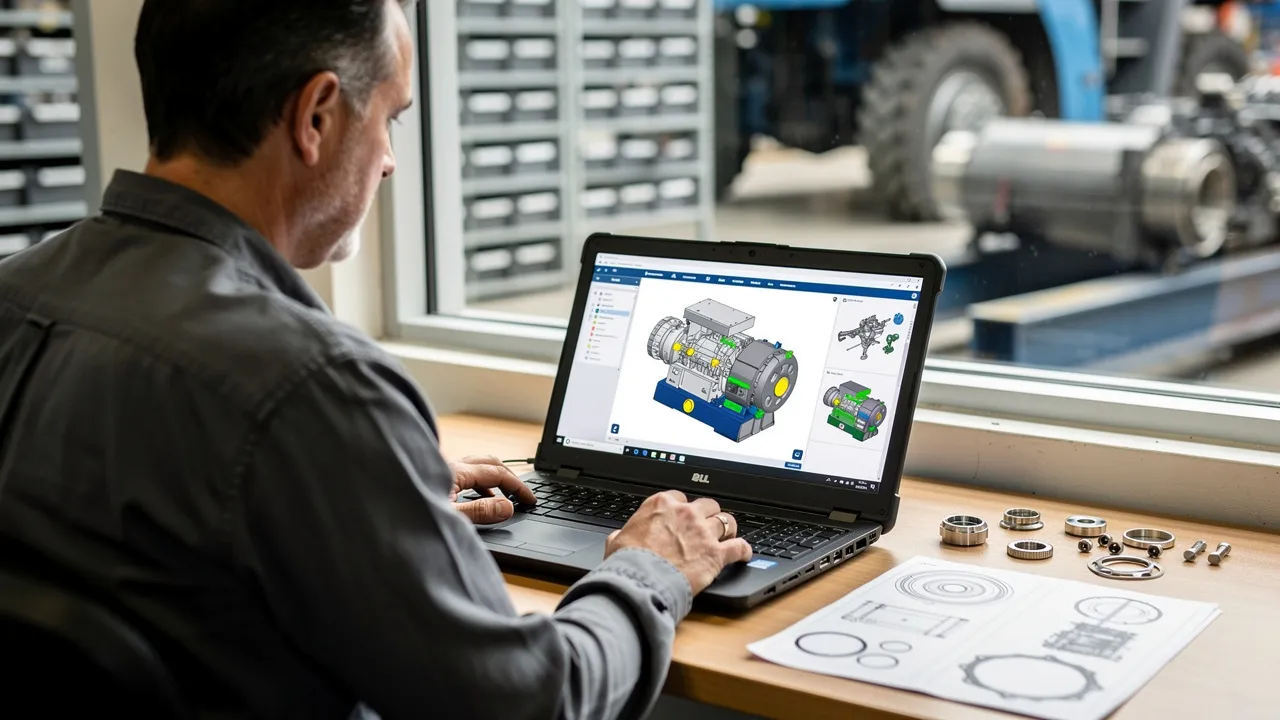
Electronic parts catalog software links parts lists to diagrams so technicians, dealers, and customers can identify and order parts. That makes interactive documentation relevant to a commerce evaluation, but a catalog and a complete purchasing experience are not automatically the same thing. Use the rest of this guide to examine the connection between those layers rather than judging a platform by its storefront features alone.
The central decision is therefore not simply whether you want a cloud storefront. It is whether the platform can preserve the relationship between a particular piece of equipment, the parts that apply to it, the commercial data attached to those parts, and the support path after selection.
That distinction matters when your service team works from engineering bills of material, your dealers need account-specific purchasing, or your customers begin with a machine rather than a part number. A platform may support online ordering in general while still requiring careful work on equipment data, applicability rules, integrations, and ownership of updates. Treat those requirements as part of the product fit, not as implementation details to postpone until after selection.
What a SaaS ecommerce platform actually provides
A SaaS ecommerce platform provides the ecommerce application as a cloud-based service. You use the platform online, while the software is not installed on your own servers in the traditional local-license model. The model is commonly associated with remote access, automatic updates, and scalability.
Those characteristics describe how the software is delivered. They do not, on their own, tell you how the platform handles equipment relationships, parts structures, dealer accounts, or service documentation. For an equipment manufacturer, separate the delivery model from the workflows you need to support.
A useful way to examine the platform is to ask what it can represent and what it can pass between systems:
- Product and parts information: Can your organization represent equipment, assemblies, part numbers, descriptions, diagrams, and applicable relationships?
- Customer interaction: Can the right users search, view, select, and purchase according to the access model you need?
- Commercial information: Can the experience use the pricing, discounts, contract terms, and account context that apply to a buyer?
- Operational handoff: Can orders, order lines, status information, and shipment updates move between ecommerce and the systems that manage fulfillment?
- Support context: Can service documentation and parts identification connect to the point where a customer or technician needs to act?
The word “platform” can make these functions sound like one unified capability. In practice, you still need to map the data and responsibilities behind each one. Electronic parts catalogs connect lists to diagrams; ERP and warehouse systems may supply inventory and availability; ecommerce may send orders to an ERP and receive order-status updates back.
That means your evaluation should distinguish three questions:
- What does the platform store or display?
- What does another system provide through an integration?
- Which team owns the accuracy and maintenance of the information?
The answers will shape the experience you can offer. A cloud delivery model may make the application easier to access, but it does not remove the need for accurate parts data, defined system relationships, or a clear operating process.
What changes compared with on-premises ecommerce
SaaS and on-premises ecommerce place different responsibilities around the application. SaaS ecommerce is commonly associated with remote access, automatic updates, and scalability. On-premises ecommerce may offer more control and customization, along with more direct control over data security; those characteristics can matter when your compliance requirements are stringent.
The practical comparison is not a simple list of winners. It is a question of which responsibilities and constraints fit your organization.
| Evaluation area | SaaS ecommerce | On-premises ecommerce |
|---|---|---|
| Access model | You access the platform online as a cloud service. | Your organization operates software installed on its own servers or systems. |
| Update responsibility | The service model is associated with automatic updates. | Your organization has more direct control over the software environment and update decisions. |
| Customization | You need to understand which workflows can be configured within the service. | The model may offer greater control and customization. |
| Data-security control | You need clear answers about the vendor’s security responsibilities and controls. | Your organization may retain more direct control over data security. |
| Compliance fit | Examine whether the service model meets your requirements. | This model may be preferred where compliance requirements are stringent. |
The table describes broad operating trade-offs, not a platform-specific result. A particular SaaS offering may support substantial configuration, and a particular on-premises environment may still have integration or data-quality constraints. Ask how the model affects your own equipment data, service workflows, and internal responsibilities.
Before you compare products, write down the responsibilities you are prepared to retain. Include application administration, data access, role management, integrations, security review, updates, and support escalation. Then ask each vendor to connect its answer to a parts-and-service scenario rather than describing the model in general terms.
For example, an equipment manufacturer might need to know who controls a serial-specific bill of material, who changes a superseded part, who approves a price update, and who investigates a failed order handoff. Those questions expose the operating model more clearly than the word “cloud” does.
The equipment-manufacturer capability test
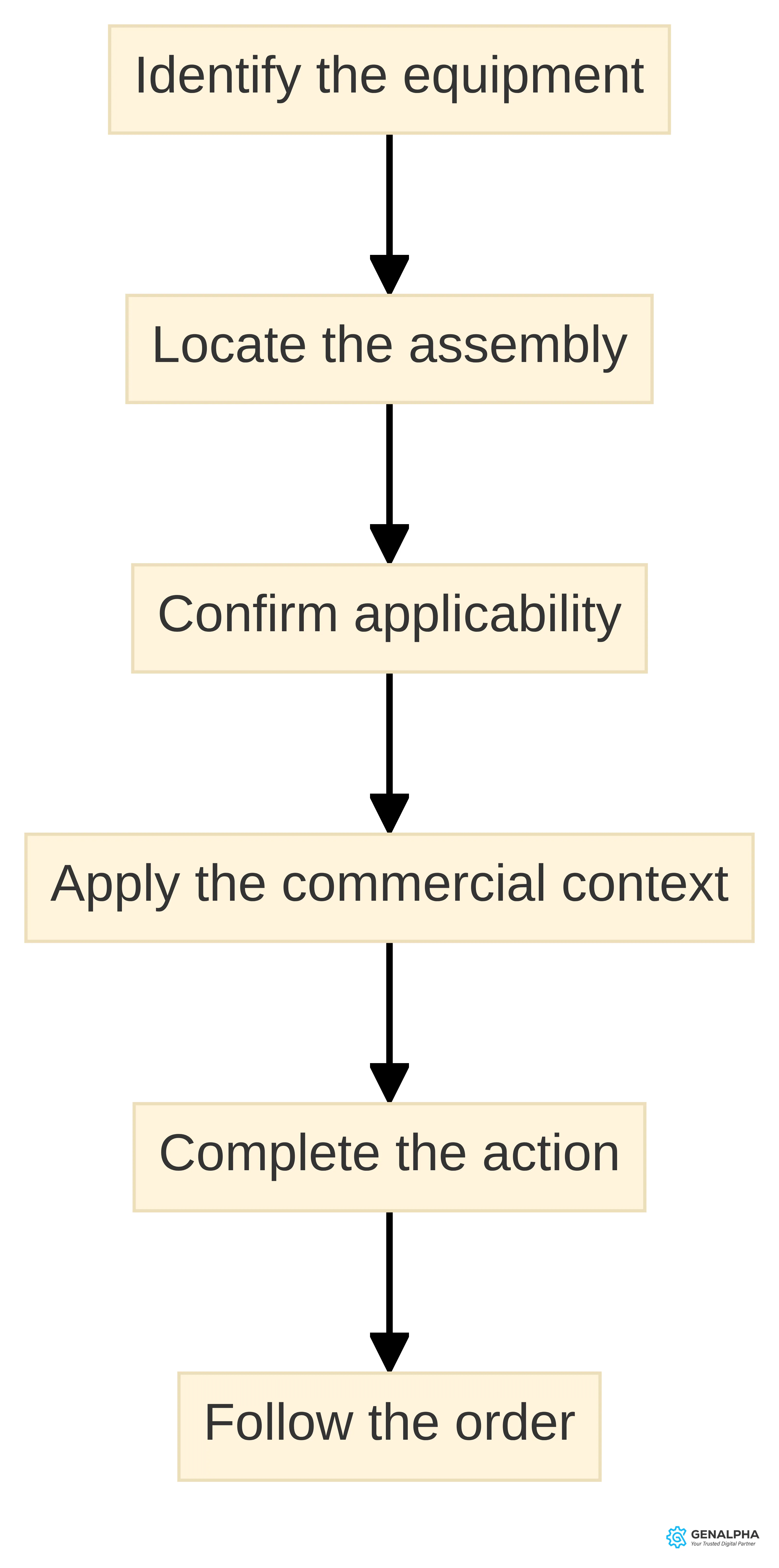
An equipment-manufacturer capability test should follow one realistic request from identification through support. Choose a machine, assembly, or replacement-part situation that reflects the work your service and warranty teams handle. Then ask whether the platform can support each stage without breaking the relationship between the equipment and the part.
Use these checkpoints:
- Identify the equipment: Start with the information your customer or technician actually has, such as a model, serial number, VIN, or part number.
- Locate the assembly: Show how the user reaches the relevant sub-assembly, diagram, or bill of material.
- Confirm applicability: Make the applicable part and any supersession or legacy relationship clear before purchase.
- Apply the commercial context: Display the price, discount, contract term, or account rule that belongs to the buyer when those values come from connected systems.
- Complete the action: Demonstrate the cart, quote, dealer handoff, checkout, purchase order, or payment-on-account path that your channel requires.
- Follow the order: Show where order status and shipment updates come from and how a support team can use them.
Electronic parts catalogs are relevant to equipment OEMs, industrial manufacturers, and aftermarket teams that still rely on static PDFs or paper parts information. ERP and warehouse systems may supply inventory and availability to ecommerce in real time or near real time. These capabilities belong in the test because an attractive catalog does not establish that the complete journey works.
Run the same scenario for the roles that use the experience. A service technician may begin with an illustration, a dealer may need account-specific purchasing, and an equipment owner may need a simple path from an identifier to a part. The platform should make those differences explicit instead of assuming that every user follows the same route.
Ask for separate demonstrations of customer access, dealer access, internal service access, and any approval or support handoff you require. If the vendor cannot show how those roles change the available information or action, record that as an open fit question rather than treating a general login screen as sufficient evidence.
Why a catalog is not the same as a parts finder
A catalog and a parts finder can support different starting points. An illustrated parts catalog typically starts with an assembly diagram and uses serial effectivity. A parts finder typically starts with the customer’s machine and mapped serial ranges. Both can help with parts identification, but they organize the journey differently.
| Shared criterion | Illustrated parts catalog | Parts finder |
|---|---|---|
| Starting point | An assembly diagram | The customer’s machine |
| Applicability signal | Serial effectivity in the catalog | Serial ranges mapped to store products |
| Main identification path | Visual navigation through an assembly | Search and fitment around the machine |
| Typical user need | Understanding which component appears in a technical assembly | Reaching a purchasable product for a known machine |
| Commercial handoff | Parts list, quote, or dealer handoff | Cart, checkout, purchase order, or payment on account |
| Common data context | Engineering bills of material and illustrations | ERP item data, product content, and fitment data |
The comparison does not mean you must choose one pattern. Your experience may need both: visual documentation for a technician inspecting an assembly and machine-based lookup for a customer who knows the equipment identity but not the part number.
Use the distinction to define your evaluation scenario. If your team receives questions such as “Which component is shown here?”, test diagram navigation, call-outs, and part-list selection. If the request sounds like “Which replacement fits this machine?”, test serial ranges, machine records, search, and product selection.
Then test what happens after identification. Neither route is automatically sufficient for every channel. Choose the path that matches who buys, who approves, and who fulfills the order in your organization.
Trace the data that makes the experience usable
A useful evaluation follows data rather than screens. Start with the part a customer sees and trace backward to the system that defines it, then forward to the systems that price, fulfill, and support it. This exposes gaps that a polished storefront can hide.
Trace these relationships:
- Product and equipment definition: Identify where product masters, equipment attributes, assemblies, and part records originate.
- Applicability: Identify how serial effectivity, configurable bills of material, supersession, and legacy numbers determine which part belongs to which equipment.
- Commercial data: Identify where pricing rules, discounts, B2B price lists, and contract terms originate. An ERP may supply these values to ecommerce in near real time.
- Availability: Identify whether an ERP or warehouse-management system supplies inventory balances and availability in real time or near real time.
- Transaction data: Identify how ecommerce orders and order lines reach the ERP. A typical integration can send them in real time.
- After-order information: Identify how order-status and shipment updates return from ERP, warehouse, or carrier systems in near real time.
The goal is not to force every data type into one application. The goal is to make each source, transfer, timing expectation, and owner visible.
Bring these questions to a vendor discussion:
- Which system is the source for each product, parts, price, inventory, account, order, and shipment field?
- Which data moves in real time, near real time, or on a batch schedule?
- What happens when the platform receives conflicting values?
- How do you identify a failed or delayed handoff?
- Who can correct an outdated part relationship or commercial value?
- How will service and warranty teams see the information they need without creating a second, disconnected catalog?
These questions turn “integration” into a concrete operating map. They also help you distinguish an available connector from a workflow that actually preserves equipment identity and applicable parts.
Test configurable product and parts structures
A configurable or matrix bill of material can represent many product variants in one structure and generate a parts list from the options selected by a customer. That model is relevant when an equipment configuration changes which assemblies, components, or replacement parts apply.
Ask the vendor to demonstrate a structure that resembles your own product range. Do not settle for a generic product with a few selectable attributes. Test the relationships that affect service and parts commerce:
- Which options change the applicable assembly?
- Can the structure represent product variants without creating a separate manual list for every combination?
- Can a serial number or other equipment identifier resolve to the correct bill of material?
- Can superseded or legacy part numbers lead to the current part number?
- Can the selected structure move into a parts list, quote, cart, or order?
- What happens when the source bill of material changes?
Connecting product configuration with CPQ and manufacturing ERP software can let sales teams calculate prices, lead times, and feasibility using production data. That possibility makes the integration boundary part of the evaluation. A configuration screen alone does not establish that the resulting parts and commercial information are usable.
Reliable product configuration depends on accurate BOMs, material costs, routing times, inventory levels, and pricing rules. Treat that dependency as a direct evaluation condition. Ask what happens when one of those inputs is incomplete, outdated, or inconsistent with another system.
Product configuration can align sales, engineering, purchasing, inventory, and production around shared product data. For a service organization, the same question becomes: can the parts experience use the applicable product structure that engineering and operations recognize? If the answer depends on manual reconciliation, document that responsibility and include it in the operating cost of the option.
Connect interactive documentation to the buying path
Interactive parts documentation can support the service experience, but the handoff into commerce still needs a defined path.
Test the complete sequence:
- Open the equipment, model, serial number, VIN, or other identifier.
- Navigate to the relevant assembly or service area.
- Select an engineering call-out or part from the illustration.
- Display the part information and applicability context.
- Show current, superseded, or related part information where your process requires it.
- Move the selection into a parts list, quote, dealer handoff, cart, or checkout path.
- Return enough order or support context for the next question.
The exact endpoint depends on your channel. A service technician may need a clear parts list and a handoff to a dealer. A dealer may need account pricing and purchase-order support. A direct buyer may need cart and checkout. Ask the vendor to demonstrate the path that matches each audience rather than presenting one generic catalog view.
Digital documentation does not replace the work of maintaining the source data. The catalog is only useful when the diagrams, parts relationships, identifiers, and applicable structures reflect the equipment you support. Make content ownership part of the platform conversation: who supplies engineering information, who updates the catalog, who approves changes, and how those changes reach the buying experience?
This boundary keeps the evaluation grounded. You are not only choosing a viewer for manuals or diagrams. You are examining whether service information can remain connected to the part-selection and purchasing route that follows it.
Make the vendor prove integration and access fit
A vendor discussion should use your equipment scenario, your source systems, and your access rules. Ask the vendor to show how the platform handles the full information path rather than listing integrations by name.
Use a short demonstration script:
- Start with a real or representative equipment identifier.
- Resolve it to the applicable assembly and part.
- Apply the account’s price or contract context.
- Add the part to the appropriate commercial path.
- Send the order and order lines to the ERP.
- Return order status or shipment information from the ERP, warehouse, or carrier system.
- Show what a service, dealer, or customer user can see at each stage.
A typical integration can send orders to the ERP in real time and return order-status and shipment updates from ERP, warehouse, or carrier systems in near real time. An ERP may also supply pricing rules, discounts, B2B price lists, and contract terms to ecommerce in near real time. Treat those timings as questions for the proposed design, not as assumptions about every vendor.
Access and security questions belong in the same evaluation. Ask about:
- Encryption for data at rest and in transit.
- Key-management responsibilities and whether the vendor or your organization manages the keys.
- Role-based access controls and granular permissions.
- Audit logging for administrative actions.
- Incident-response plans and notification timelines.
- Third-party penetration testing and what results or summaries can be shared.
- Subprocessor vetting and monitoring.
Then map those answers to your own users and data. A dealer should not automatically have the same access as an internal service employee, and a customer’s view may need a different boundary again. The vendor’s answer should be specific enough for your security and operations teams to assess the proposed arrangement.
Test the SaaS service boundary with vendor answers
Evaluate a SaaS ecommerce platform by the service boundary it defines, not by the subscription label alone. For an equipment manufacturer, make the SaaS question concrete: ask the vendor to demonstrate one equipment-parts workflow and show what the subscription covers and what depends on connected systems, parts data, configuration, or implementation work..
Ask the vendor to walk through a representative equipment scenario and show:
- how a serial number or another equipment identifier connects to the applicable BOM;
- how diagrams and parts lists support identification and an order or quote;
- how pricing, contract terms, inventory, orders, and shipment updates would exchange with ERP or WMS systems;
- how customer, dealer, and service access would be handled with roles, permissions, and audit logging; and
- how interactive service documentation fits into the buying and support path.
Then separate what the SaaS subscription covers from what depends on your parts data, connected systems, configuration, or implementation work. The subscription model describes how the software is provided; it does not, by itself, answer whether the proposed design fits your equipment and service requirements.
A fit decision becomes clearer when you record what you gain and what responsibility remains. For each option, write down the access model, update responsibility, customization boundary, data-security controls, integration work, and compliance questions. Then assign an owner for each unresolved item.
If your organization requires more control over customization or data security, make the reason explicit and test whether the SaaS model can meet that requirement. If your organization values remote access or a service-based operating model, still test the data and workflow conditions that matter to equipment support. The right conclusion may be to continue evaluating SaaS, retain an on-premises approach, or narrow the scope to a controlled parts-and-service use case.
Use Equip360 as a capability example, not a universal answer
We use Equip360 as a concrete example of the capability questions in this guide, not as a universal answer for every equipment manufacturer. We design Equip360 specifically for parts dealers and manufacturers. During discovery, we work with each company to identify the equipment and parts data needed for its ecommerce launch. They do not remove the need to test your own source systems, access model, operating responsibilities, or compliance requirements.
We provide multiple ways for users to find parts in Equip360, including a global search tool and a “shop for parts” tab. Equip360 allows equipment owners, operators, and technicians to search by serial number, VIN, or another unique identifier for a specific bill of material, review interactive sub-assemblies, and add parts to a shopping cart from 2D or 3D drawings. Equip360 also stores supersession, obsolescence, vendor, cross-reference, and legacy part-number data from the ERP to link customers to the current part number.
We have implemented deep linking between Salesforce Service Bills of Materials and Equip360 product-detail pages for Milacron. In one ERP-transition project, we addressed the challenge of keeping ecommerce running without disrupting order management. These examples show the kinds of integration and continuity questions you can bring to a vendor conversation. They are not a substitute for a scenario-specific evaluation of your equipment data and service workflows.
Decide what evidence would justify a next conversation
A SaaS evaluation is ready for a deeper conversation when you can describe the information path you need to preserve and the trade-offs you are prepared to accept. Before moving forward, write down the answers to these questions:
- Can the platform begin with the equipment identity your customers, dealers, and technicians actually use?
- Can it resolve that identity to an applicable parts structure, including variants, serial effectivity, supersession, or legacy numbers where needed?
- Can the commercial path use the pricing, account, inventory, order, and status data your process requires?
- Can interactive documentation connect a visual parts choice to a quote, handoff, cart, or checkout action?
- Can your teams define who owns data accuracy, access, updates, integrations, and support exceptions?
- Can the vendor demonstrate the scenario and answer your security, integration, and compliance questions with enough detail for internal review?
Your technical, operations, service, and security professionals should decide whether the model fits your organization’s requirements. Keep the decision tied to a representative parts-and-service journey, not to a general promise about cloud software. If the answers expose a manageable set of open questions, take that scenario into a focused vendor discussion.
A focused discussion can begin with the equipment and parts data you need to organize, the customer and dealer paths you need to support, and the system handoffs you need to see. Bring one representative equipment scenario, one applicable parts structure, and one order or support workflow so the conversation stays tied to your operating needs.
Questions to ask before evaluating a SaaS ecommerce platform
What is a SaaS ecommerce platform?
A SaaS ecommerce platform is a cloud-based service that provides ecommerce software accessible over the internet, typically on a subscription basis, rather than requiring local installation.
What capabilities should equipment manufacturers look for in a SaaS ecommerce platform?
Manufacturers should evaluate the platform's ability to manage product and parts data, support parts identification, facilitate purchasing, and provide access to service documentation and workflows.
What are the key evaluation criteria for choosing a SaaS ecommerce platform?
Consider factors such as integration with existing systems, configurable parts structures, customer and dealer access, ongoing platform management, and vendor support.
What questions should be asked during a vendor evaluation of a SaaS ecommerce platform?
Inquire about data ownership, integration capabilities, security measures, compliance with regulations, and how the platform supports specific equipment and service workflows.
Sources
- Product Configuration Guide for Manufacturing SMBs | MRPeasy — www.mrpeasy.com
- Ecommerce ERP Integration: How It Works & Methods (2026) — virtocommerce.com, 2026-09-15
- Electronic Parts Catalog Software: Guide + Best Tools 2026 | VNTANA — www.vntana.com, 2026-07-01
- Parts Catalog Software vs a Parts Finder in Your Store — www.iwdagency.com, 2026-10-27
- Advantages of SaaS Ecommerce over On-Premise | Icreon — www.icreon.com
- What Is an SaaS eCommerce Platform? | Crystallize — crystallize.com, 2026-01-29
- How to Evaluate SaaS Vendors: 8 Checks Before You Sign — launchdayadvisors.com