
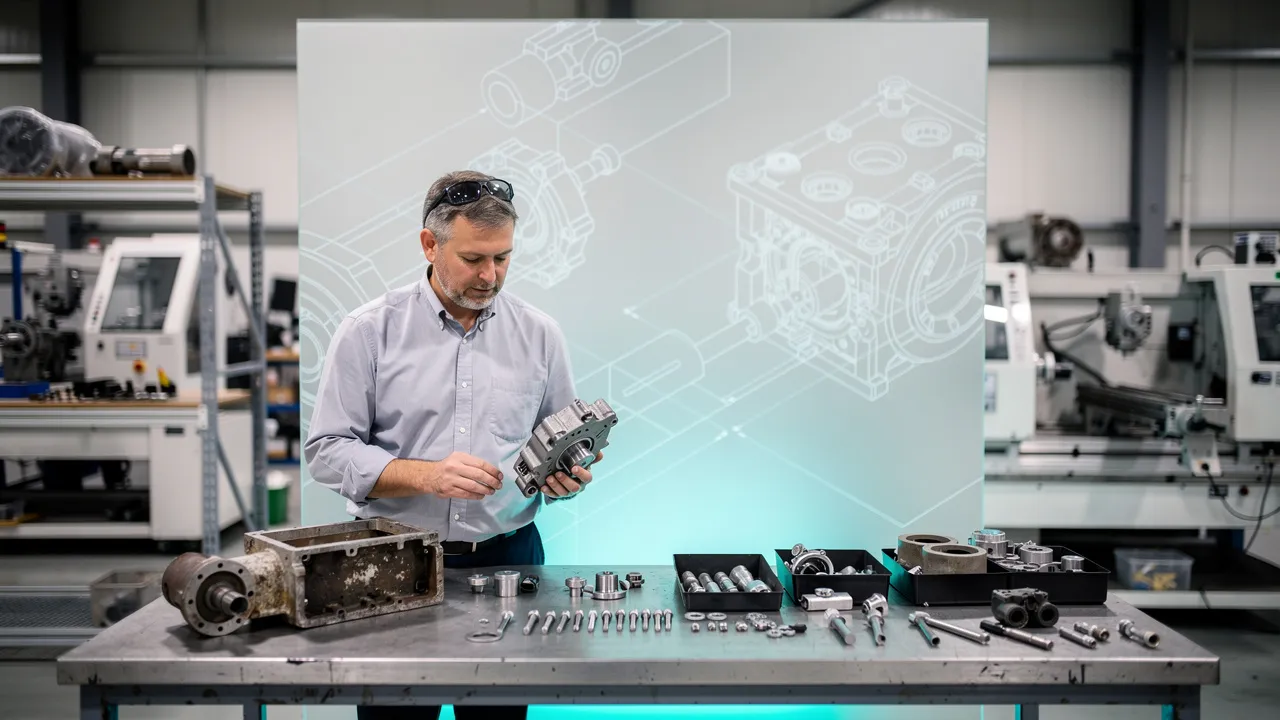
Start with the information problem behind parts purchasing
Equipment parts purchasing starts with identification, not checkout. When you need a replacement for a machine, you may have only a worn component, a faded serial number, an old document, or a blurry photo. Your customer, dealer, or service team may face the same uncertainty. A digital parts experience is relevant when it helps turn that incomplete starting point into a part record, a clear product relationship, and a practical path toward the next action.
An interactive parts manual can give customers current information and simplify the process of purchasing equipment parts. That does not mean every manufacturer needs the same interface or the same platform. It means your evaluation should begin with the information problems your teams and channels need to handle.
The right starting question is not “Should we add a parts portal?” Ask a more useful question: Which parts-identification and support situations create enough friction to justify a connected digital experience?
Use these questions to frame the decision:
- What information does someone have when they begin searching for a replacement?
- Which equipment, model, serial-number, or assembly relationships must be visible?
- Where does the identified part go next: a quote, a dealer, a cart, an internal request, or a service conversation?
- Which customer and dealer paths should share data, and which should remain different?
- Can your existing parts and business-system data support the experience you want to present?
Manufacturers that sell through dealers can choose direct sales, dealer-routed orders, dealer storefronts, or a combination by market. There is no single channel model that fits every business. Decide the operating path before judging a technology fit.
Overview
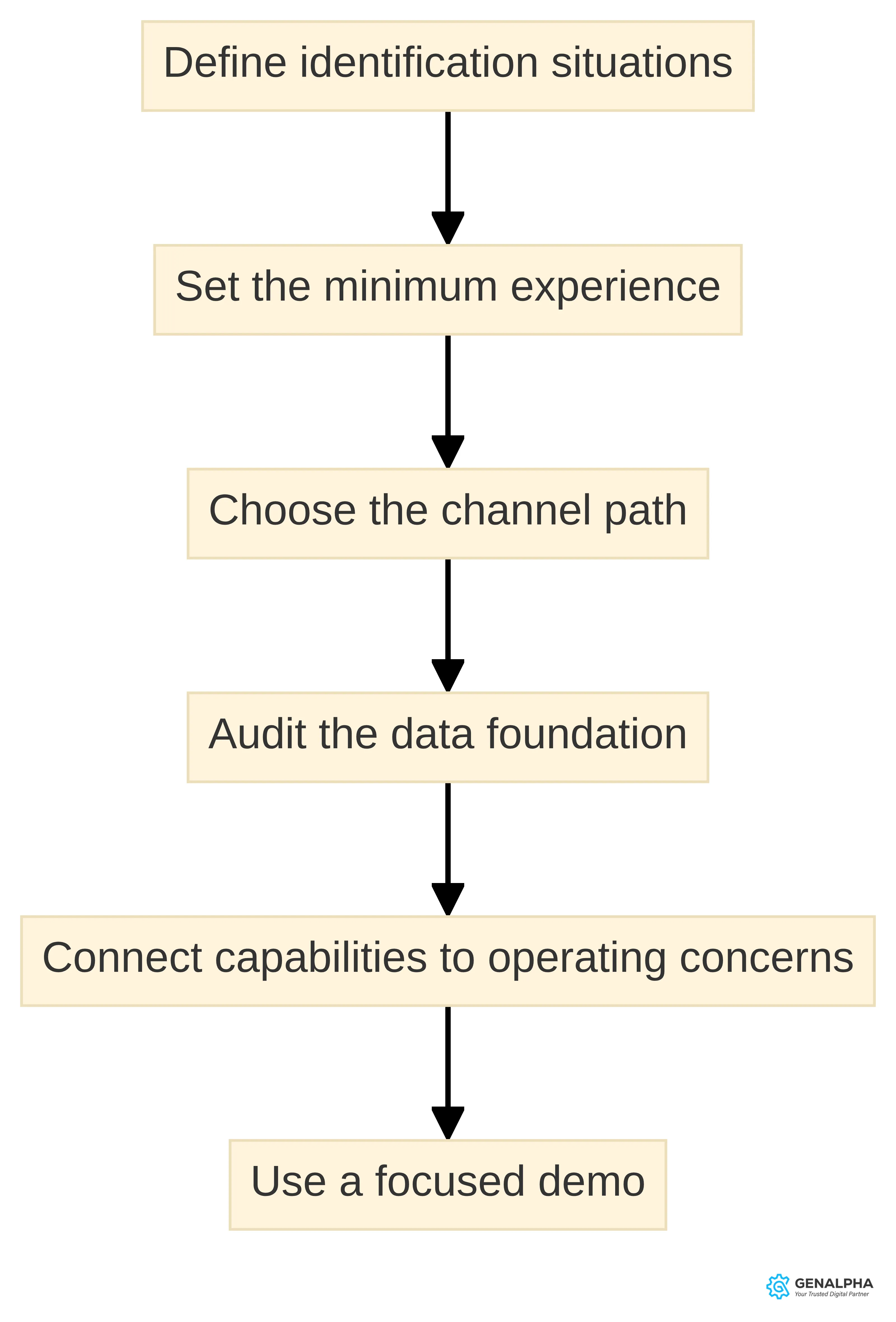
A digital parts investment deserves a fit test built from the information foundation outward. The sequence below keeps the discussion tied to equipment support rather than to a generic online store.
- Define the identification situations. Describe how customers, dealers, technicians, and internal teams search for parts when they do not begin with a clean item number.
- Set the minimum experience. Decide which combination of visual context, equipment relationships, parts structure, product information, purchasing, and support the first release must address.
- Choose the channel path. Establish whether the journey is direct, dealer-led, dealer-branded, or mixed across markets and customer groups.
- Audit the data foundation. Review engineering data, ERP records, item masters, equipment relationships, BOMs, pricing, order details, and the ownership of each field.
- Use a focused demo. Bring a real equipment family, a realistic identification problem, and your system questions. Evaluate the fit of the workflow, not just the appearance of the interface.
This approach gives you a record for the decision. It also gives your internal team a shared way to distinguish a data problem, a process problem, and a platform question.
A focused evaluation is justified when your organization can name a recurring parts-identification problem, identify the information needed to resolve it, and explain what should happen after identification. A demo can then test the proposed journey against your systems and goals.
A platform discussion is premature when the desired experience is still described only as “more digital” or “better self-service.” First write down one or two concrete journeys, such as identifying a replacement from a serial number or navigating an illustrated assembly to the required part. The sharper the journey, the easier it is to discuss scope, data dependencies, channel ownership, and open questions.
Define the parts-identification situations you need to support
Parts identification means different things across an equipment business. A service technician may start with a damaged component. A fleet operator may know the machine serial number but not the part number. A dealer may recognize the assembly from an exploded view and need to confirm the bill of materials before placing an order. Your digital parts experience should be designed around these starting conditions rather than around a single ideal search.
Map the situations you want to support:
- Serial-number search: You begin with a machine identifier and need the parts or assemblies associated with that equipment configuration.
- Visual assembly search: You begin with a 2D or 3D exploded view and select the callout that matches the component.
- BOM navigation: You begin with a bill of materials and need to move from an assembly to the relevant item.
- Known-item search: You already have a part number, description, or internal reference and need product information or a purchasing path.
- Limited-information search: You have a worn component, faded identifier, or blurry photo and need a way to narrow the possibilities before ordering.
- Dealer-assisted search: You need a dealer or support team to participate in identification, pricing, ordering, or fulfillment.
CDS Visual describes part identification through serial numbers, 2D/3D exploded views, BOMs, and AI-powered image search. Treat those methods as possible evaluation criteria, not as a reason to assume every method belongs in your first release.
For each situation, record the evidence available at the start and the decision required at the end. This simple map keeps the conversation practical.
| Starting information | Identification question | Required next step |
|---|---|---|
| Serial number or equipment identifier | Which configuration and parts relationship applies? | Open the relevant equipment or assembly context |
| Exploded view or engineering callout | Which item matches the physical component? | Display the item record and purchasing conditions |
| BOM or assembly reference | Which components belong to this assembly? | Move from structure to selected part |
| Part number or description | Is this the intended item and revision? | Present product information and available route |
| Worn component or unclear image | What information can narrow the search? | Escalate, refine, or continue with a supported search path |
The map should also identify where a person must make a judgment. A digital tool can organize information and guide a search, but your organization still needs rules for substitutions, revisions, compatibility, approvals, and exceptions. Keep those rules visible in the evaluation instead of assuming that a catalog interface resolves them automatically.
Set the minimum digital parts experience
The minimum digital parts experience should connect identification with a usable next step. An interactive manual can give customers current information and simplify the process of purchasing equipment parts. A digital spare-parts portal can provide customers, dealers, and distributors with 24/7 access to spare-parts catalogs and essential product information. Your own minimum should translate those general capabilities into requirements for your equipment, channels, and support model.
Define the minimum across five layers:
- Context: Show the equipment, model, serial-number range, assembly, or other relationship that gives the part meaning.
- Identification: Provide the search or navigation methods that match your real starting situations, such as known-item search, serial-number lookup, visual selection, or BOM navigation.
- Part information: Present the fields needed to distinguish the item, including description, identifiers, relationships, and any conditions your team requires before purchase.
- Commercial action: Decide whether the next step is adding an item to an online order, requesting a quote, sending the selection to a dealer, or opening a support conversation.
- Continuity: Define what happens after selection, including order details, shipment information, follow-up, repeat purchase, and human assistance where applicable.
This list is a decision framework, not a promise that every platform supports every layer in the same way.
Evaluate the experience with a small set of realistic tasks rather than a feature inventory. Ask whether you can complete the following without losing the equipment context:
- Identify a part from a representative equipment record.
- Move from an assembly or parts structure to a specific item.
- Distinguish the selected item from similar items or possible alternatives.
- See the information required by your customer, dealer, service, and purchasing teams.
- Continue into the correct commercial or support path.
- Return to the same equipment and part context when you need order or service follow-up.
CDS Visual describes e-commerce integration for identifying, searching for, and purchasing spare parts. GenAlpha states that Equip360 connects product data, parts structure, and commerce capabilities into one experience. During an evaluation, ask how those relationships would be represented for your equipment families and how the handoff would work for each channel. Keep the question specific enough to expose data and process dependencies.
Choose the customer and dealer path before choosing the platform
Channel design changes the parts experience. A direct customer may need a public or account-based purchasing path. A dealer may need a branded storefront, negotiated commercial terms, or a route that keeps the dealer responsible for the transaction. A service team may need identification without immediate online checkout.
Manufacturers can choose direct sales, dealer-routed orders, dealer storefronts, or a combination by market. Write the channel decision in operational terms before you compare platforms.
| Channel path | What you need to decide | Fit question |
|---|---|---|
| Direct purchase | Who can search, buy, and receive order information directly? | Can the journey expose the right catalog, account rules, and commercial action? |
| Dealer-routed order | When does the dealer take ownership of the transaction? | Can identification pass to the selected dealer without losing the part context? |
| Dealer storefront | Which catalog, brand, customer group, and permissions apply? | Can the experience support a dealer-specific journey without creating duplicate parts records? |
| Mixed by market | Which rule applies by region, account, product, or transaction? | Can your operating team maintain the differences without making every catalog change a rebuild? |
A parts platform may present different catalogs, assortments, and journeys to different channels without duplicating the underlying parts data. Treat that as a design criterion to test. Do not treat it as evidence that any particular implementation will fit your organization.
Your channel map should name ownership as well as presentation. Record who owns each decision:
- Who maintains the shared part and equipment information?
- Who decides which items each channel can see?
- Who owns pricing, terms, order approval, and fulfillment communication?
- Who handles an identification exception or a suspected mismatch?
- Who receives the interaction when a customer needs dealer assistance?
This work matters because a visually polished catalog can still create operational confusion if the next action is unclear. A channel-specific experience should make responsibility visible. If your organization has no agreed owner for a step, capture that as a process gap rather than hiding it inside a platform requirement.
Audit the data foundation behind the parts experience
A digital parts experience is only as useful as the information behind the identification path. Audit the data before you judge the interface. Start with the records that define what the customer can find and what your teams can act on.
Check these areas:
- Equipment identity: models, configurations, serial-number ranges, revisions, and relationships between equipment and assemblies.
- Parts structure: BOMs, engineering callouts, parent-child relationships, supersessions, and item references.
- Commercial records: item masters, descriptions, pricing rules, account terms, and purchasing conditions.
- Availability and movement: the fields your organization uses for inventory, order, shipment, and invoicing information.
- Content ownership: the person or team responsible for correcting each field and approving changes.
- Channel rules: the catalog, assortment, account, and journey differences that apply by market or customer group.
GenAlpha provides data-conversion services to help manufacturers organize parts data for e-commerce sales channels. GenAlpha also states that it uses data-conversion tools to transform ERP and engineering 2D data into a customer-friendly format. Use those stated services as topics for a scope discussion, not as an assumption about the condition of your data.
An audit should follow each important field to its source and its destination. Ask where the value originates, how often it changes, who can correct it, and what the customer or dealer sees when the value is missing. A platform conversation becomes more useful when you bring examples of duplicate item descriptions, incomplete relationships, outdated engineering files, or conflicting identifiers.
GenAlpha also states that it uploads data into the Equip BOM database and populates an interactive eCatalog with engineering call-outs. GenAlpha’s integration process begins with understanding your current systems and goals. These are specific areas to examine in a demo and scoping conversation.
Prepare a data-readiness sheet with four columns: field or relationship, current source, known issue, and decision owner. Add a fifth column for the experience that depends on it. That sheet helps you distinguish “the platform cannot do this” from “the required information has not been organized or assigned.”
A practical readiness review does not require every record to be perfect before you begin. It does require you to know which equipment family, parts structure, and system records will represent the evaluation. Select a bounded sample and test it end to end.
Use a sample that includes:
- One equipment family with a meaningful assembly structure.
- One serial-number or configuration distinction.
- Several parts that are easy to confuse.
- One part with a known revision or substitution question.
- One commercial or dealer rule that changes the next step.
Bring the sample into the demo discussion. A real, bounded data set will expose more useful questions than a broad request to “see the catalog.”
Connect the experience to operating concerns without promising outcomes
If your sales process depends on repeated manual identification, evaluate whether the proposed journey gives customers and dealers a clearer route to the correct item. If customer engagement suffers because product information is difficult to access, evaluate the information and support path. If inventory accuracy is a concern, evaluate the source, ownership, and synchronization of the item and availability fields.
An interactive parts manual can give customers current information and simplify equipment-parts purchasing. Digital spare-parts tools can help teams identify and source replacements when they are working from limited information such as a worn component, faded serial number, or blurry photo. These statements describe possible practical value; they do not predict a conversion rate, a reduction in wrong-part orders, or an improvement in inventory accuracy for your organization.
Keep the evaluation grounded in observable tasks:
- How many steps are required to reach the relevant assembly?
- Which information is visible before a commercial commitment?
- Where can a person pause and ask for assistance?
- What happens when the part record is incomplete or ambiguous?
- Which system owns the information shown at each step?
Deloitte reported on September 23, 2024, that 86% of respondents who answered as B2B customers agreed or strongly agreed that they wanted an improved digital customer interface from suppliers. Use that result as context for why interface quality can matter in industrial purchasing, not as a forecast for your own customers.
Your operating review should translate those broad preferences into testable questions. “Clear information” may mean a visible equipment context, a readable engineering callout, a distinguishable part description, or an explicit exception path. “Faster response” may mean fewer handoffs, a clear dealer route, or access to order details. Define the specific condition before you discuss whether a platform can support it.
Channel choice also affects the outcome you are trying to improve. A direct store may change who owns the transaction. A dealer-routed path may preserve dealer participation while changing how identification is shared. A mixed model may require different catalogs and journeys by market. Do not evaluate a parts experience only by how quickly it reaches a cart; evaluate whether it supports the commercial and service rules your organization has chosen.
Prepare a focused demo evaluation
A focused demo should answer fit questions that your team cannot answer from a feature list. GenAlpha states that its demo includes a live look at tools that help businesses sell online. GenAlpha also states that the Equip360 integration process begins by understanding your current systems and goals. Use that meeting to show your real decision path and ask what would be required to support it.
Bring a short evaluation brief:
- The equipment family and parts sample you want to use.
- The starting information available to a customer, dealer, or technician.
- The identification path you expect to follow.
- The commercial or support action that should come after selection.
- The systems that own customer, item, order, shipment, and invoice details.
- The channel rules that change the journey.
- The open concerns your team needs to resolve before advancing.
Ask the demo team to walk through the same scenario from more than one role. A useful question set includes:
- Identification: How would a person move from a serial number, assembly, BOM, or known item to the relevant part?
- Data: Which records supply the equipment context, parts relationships, item details, and commercial fields?
- Exceptions: What happens when the item is ambiguous, the relationship is incomplete, or a person needs assistance?
- Channels: How would the journey differ for a direct customer, dealer, distributor, or internal support team?
- Commerce: What action follows identification, and which information is required before that action?
- Integration: Which ERP or internal systems would provide customer, item, sales-order, shipment, and invoicing details?
- Ownership: Who maintains the information and approves changes?
- Scope: Which parts of the proposed experience are available in the evaluated configuration, and which require additional decisions or work?
GenAlpha offers assistance with building an ROI model and establishing metrics to support an internal business case for Equip360. If that discussion is relevant to your process, bring the operational measures your team already tracks. Do not substitute a projected model for observed baseline information.
Score the demo against your decision criteria, not against presentation quality. Use a simple record with these fields:
- Scenario tested.
- Result observed.
- Data or integration dependency.
- Channel or permission condition.
- Unanswered question.
- Internal owner for the next investigation.
A strong next step is a documented question with a named owner and a bounded data or workflow example. A weak next step is a general impression that the platform “looks right.” Your scorecard should make the difference visible.
Separate Equip360’s stated scope from general guidance
General digital-parts guidance gives you a way to frame the problem. It does not decide what a particular implementation will include. The general questions are whether your customers and dealers can identify parts, access useful information, follow the correct commercial path, and receive appropriate support. The implementation questions are which data sources, rules, integrations, permissions, and workflows will make those paths work for your organization.
Keep these categories separate:
- General practice: Map identification situations, define the minimum experience, assign data ownership, and decide channel responsibility.
- Evaluation criterion: Test serial-number context, visual or BOM navigation, part information, commercial handoff, order continuity, and exception handling against your sample.
- Provider-specific scope: Ask what GenAlpha and Equip360 would provide, what data-conversion work would be required, how integration would be approached, and which questions belong in implementation planning.
We offer a product called Equip360. Equip360 connects product data, parts structure, and commerce capabilities into one experience. We provide data-conversion services to help manufacturers organize parts data for e-commerce sales channels, and we use data-conversion tools to transform ERP and engineering 2D data into a customer-friendly format. We upload data into the Equip BOM database and populate an interactive eCatalog with engineering call-outs.
We begin the Equip360 integration process by understanding your current systems and goals. We can also assist with building an ROI model and establishing metrics to support your internal business case for Equip360.
These are GenAlpha’s stated capabilities and process points. Use them to structure questions about your equipment data, system landscape, and business case. Keep the final scope tied to the specific workflows, records, channels, and decisions your organization brings to the evaluation.
The stated demo scope is a live look at tools that help businesses sell online. A demo is therefore a place to examine the proposed parts and commerce journey, surface data dependencies, and define follow-up questions. It is not a substitute for documenting your own channel rules, information ownership, exception handling, or internal approval process.
Key Highlights
A useful digital parts decision rests on five connected judgments:
- Start with the identification problem. Define what customers, dealers, technicians, and support teams know at the beginning of a search and what they need to decide next.
- Specify the minimum experience. Connect equipment context, parts structure, item information, commercial action, and post-selection continuity.
- Choose the channel path first. Direct sales, dealer-routed orders, dealer storefronts, and mixed models carry different ownership and journey requirements.
- Audit the data foundation. Trace equipment, BOM, engineering, item, customer, order, shipment, and invoice information to its source and owner.
- Make the demo prove fit. Bring a real equipment sample, test the identification path, examine system dependencies, and record unanswered questions.
Interactive manuals and digital spare-parts portals can support access to parts information and purchasing workflows. Those possibilities become meaningful only when they match the information and channel conditions of your equipment business. GenAlpha’s stated Equip360 scope, data-conversion services, integration approach, and live demo can form the basis for a focused discussion, but your organization still needs to define the scenarios and decisions that the discussion must address.
Before moving forward, make sure your team can answer these questions:
- Which parts-identification situation will you test first?
- Which equipment and parts records will represent that situation?
- Which customer, dealer, or internal role owns the next action?
- Which data and systems must supply the experience?
- Which result would justify more detailed evaluation, and which boundary would stop the process?
A clear answer to those questions gives you a focused basis for deciding whether the next conversation is worth scheduling.
Decide whether a focused Equip360 evaluation is justified
Your equipment business may have a strong case for further evaluation when a recurring parts-identification problem is clear, the desired customer or dealer path is defined, and the supporting data and systems can be examined through a bounded scenario. The goal is not to adopt a digital parts experience because it is fashionable. The goal is to determine whether a connected approach can address a specific information and support problem within your operating model.
Prepare one representative equipment family, one realistic parts-identification journey, your channel rules, and your system questions. Then use the live discussion to examine scope, data preparation, integration, ownership, and the next decision. A qualified professional from your organization should determine individual organizational suitability, including technical, procurement, legal, and compliance considerations.
If your team can describe the problem, the required information, and the path after identification, you have enough structure for a focused conversation.
What should an equipment manufacturer prepare before requesting a demo?
How can interactive parts manuals improve the purchasing process?
Interactive parts manuals provide customers with up-to-date information, allowing them to easily identify the parts they need.
What should equipment manufacturers consider when evaluating a digital parts platform?
Manufacturers should assess their specific parts-identification situations, the minimum experience required for users, the channel paths for sales, and the data foundation that supports the digital experience. It's also important to evaluate how the platform can address operational concerns without making unsupported promises.
How does GenAlpha's Equip360 platform support parts identification and purchasing?
Equip360 connects product data, parts structure, and commerce capabilities into one integrated experience. It offers features like real-time inventory insights, order tracking, and interactive parts manuals, which help streamline the parts identification and purchasing process.
What steps should manufacturers take before requesting a demo of Equip360?
Before requesting a demo, manufacturers should define their parts-identification challenges, identify the necessary data and systems, and prepare specific scenarios they want to evaluate. This preparation will help ensure that the demo addresses their unique needs.
What types of customer and dealer paths can be supported by a digital parts experience?
A digital parts experience can support various paths, including direct customer purchases, dealer-routed orders, and dealer-branded storefronts. The choice of path will depend on the manufacturer's operational model and customer engagement strategy.
Sources
- FAQs | GenAlpha Technologies — www.genalpha.com
- How OEMs Can Use Interactive Parts Manuals for Aftermarket Success — www.genalpha.com, 2022-04-20
- Parts Identification for Material Handling OEMs - CDS Visual — cdsvisual.com
- Selling Spare Parts Online: Aftermarket eCommerce for Equipment Manufacturers — www.mckennaconsultants.com, 2026-06-28
- Improve Customer Experience with Spare Parts Portals — dynamicweb.com
- The future of the digital customer experience in industrial manufacturing and construction — www.deloitte.com, 2024-09-23
- What is Spare Parts Digitalization - CDS Visual — cdsvisual.com
- Data Conversion
- Request a Demo of Equip360 | GenAlpha Technologies