
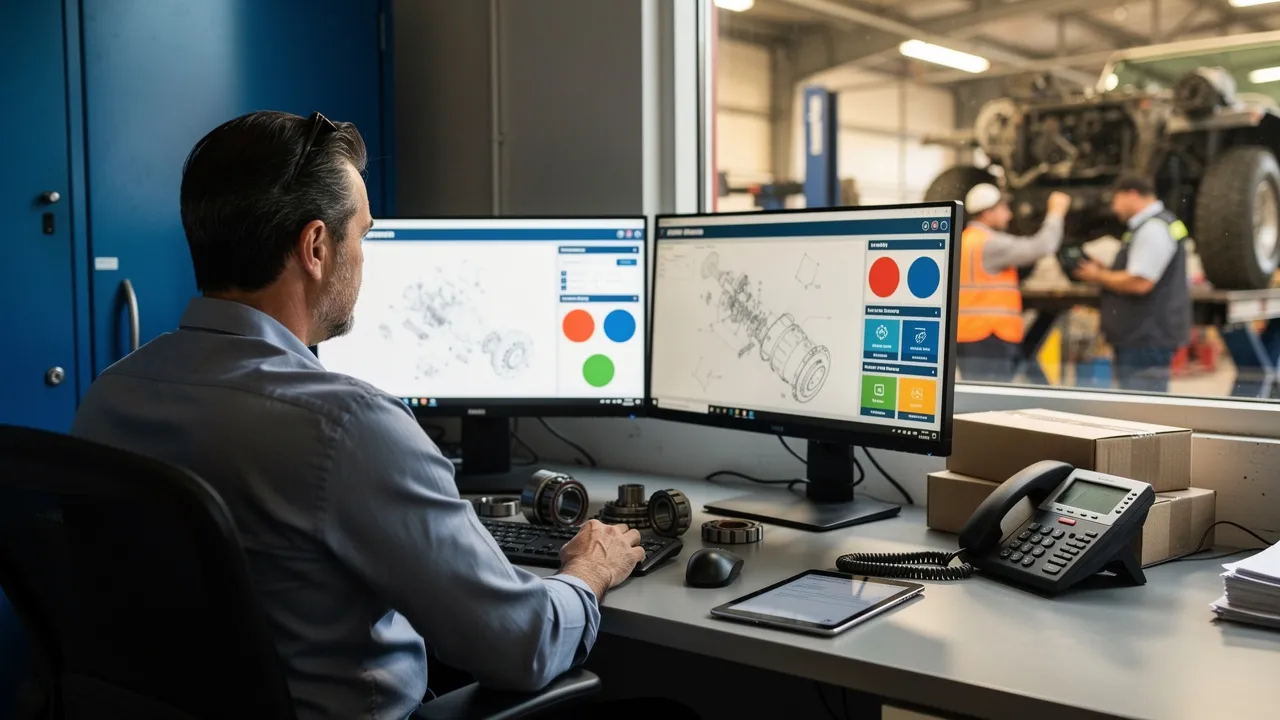
What GenAlpha Technologies does for equipment and aftermarket-parts businesses
GenAlpha Technologies works with original equipment manufacturers, distributors, and aftermarket organizations on their digital commerce journey. We offer a product called Equip360, and we position it as a solution for equipment support and maintenance. For a dealer or parts distributor, that means the relevant question is not simply whether you can add an online catalog; it is whether the experience can connect parts and equipment commerce with the support work that follows a purchase.
Equip360 is the product to examine when your teams are balancing phone and email orders with requests for parts information, order visibility, invoices, warranty help, or equipment documentation. Its stated scope brings commerce and support into the same conversation, while the details of your own data, account rules, and assisted-service boundaries still need to be discussed.
Our work is aimed at businesses that sell or support equipment and aftermarket parts, including manufacturers, distributors, and organizations serving equipment owners. We designed Equip360 to help manufacturers unify service, commerce, and customer engagement, and we position it around equipment support and maintenance. That makes the platform relevant to a dealer workflow that extends from identifying a part to completing an order and finding the information needed after the transaction.
You can use that scope as a starting point for evaluation. Ask which parts of your current process should move online, which records must remain connected to your existing systems, and where a person still needs to assist with a technical or unusual request.
Equip360 connects commerce with equipment support
We designed Equip360 to help manufacturers unify service, commerce, and customer engagement. We also position it as a solution for equipment support and maintenance. In practice, that gives you a way to discuss online purchasing and ongoing equipment support together rather than treating them as unrelated projects.
For example, a dealer may need to identify a part from equipment information, place an order, and later retrieve transaction details. A support team may need a different route for an RMA or warranty matter. Treat those as separate workflow questions during evaluation, even when they are discussed within the same platform.
One way to keep that discussion precise is to separate Equip360’s stated scope into four questions:
- Commerce: Equip360 supports online product ordering, order-status checks, and invoice retrieval.
- Equipment information: Digital 2D and 3D bills of materials catalogs, plus an interactive eCatalog with engineering call-outs, relate to how equipment and parts information is presented.
- Configuration: The Product Configurator tool and the Salford example make configuration and quoting a separate topic to examine rather than an assumption about every ordering path.
- Support beyond ordering: RMA and Warranty tools, together with the stated equipment-support and maintenance position, justify asking how support requests are handled beyond the initial ordering task.
This is a scope map, not a promise that every layer uses the same records or permissions. The useful question is how the layers relate in your operation: whether a user begins with an equipment record, a part, an account, or a support request; which information is required at that point; and where a staff handoff occurs. Keeping those questions separate helps you evaluate a platform that spans commerce and support without treating a feature name as proof of a complete workflow.
Equip360 product scope and customer applications
GenAlpha Technologies partners with original equipment manufacturers, distributors, and aftermarket organizations to support their digital commerce journey. It offers Equip360 as a product positioned for equipment support and maintenance. Together, these capabilities give Equip360 a scope that spans equipment support and maintenance as well as digital commerce, rather than presenting it as a standalone eCommerce storefront.
Customer examples add context to that product scope. Alamo Group partnered with GenAlpha to implement Equip360 as a centralized dealer platform. M-B Companies implemented our Equip360 interactive parts manuals to improve customer satisfaction and support. We worked with Salford Group around opportunities to simplify configuration and quoting, provide dealers with direct access to parts ordering, and reduce manual administrative work. Humphrey Service Parts aims to reduce dependency on phone and email support for routine transactions with its new eCommerce platform.
These examples describe particular applications and aims, not a promise of the same results for another organization. They do not establish pricing, implementation timelines, a complete set of integrations, or outcomes beyond those described for the named organizations. Our demo includes a live look at tools that help businesses sell online.
Key Highlights
The main points to carry into an Equip360 evaluation are:
- Routine online actions are defined. Customers can order products, check order status, and retrieve an invoice online through Equip360.
- Customer applications are specific, not universal promises. Alamo Group partnered with us to implement Equip360 as a centralized dealer platform. M-B Companies implemented our interactive parts manuals to improve customer satisfaction and support.
- A live review is the next practical test. Our demo includes a live look at tools that help businesses sell online.
Use these points to frame questions about your own dealer roles, parts information, order states, invoice access, and support handoffs.
What Equip360 is positioned to support
GenAlpha Technologies partners with original equipment manufacturers, distributors, and aftermarket organizations to support their digital commerce journey. We offer a product called Equip360, which we position as a solution for equipment support and maintenance.
Equip360 is positioned around equipment and aftermarket-parts work that continues beyond a product listing. Its stated scope includes digital 2D and 3D bills of materials catalogs, RMA, Warranty, and Product Configurator tools, alongside online product ordering, order-status checks, and invoice retrieval.
For a dealer or parts distributor, those capabilities connect product and parts information with the customer and transaction details that support commerce. The relevant records can include customer, item, sales-order, shipment, and invoicing details.
This makes Equip360's documented role broader than a checkout page: it is presented as a platform for equipment commerce and support. The exact roles, account visibility, and workflow boundaries are matters for the individual business to define.
The path may differ by account type. Your dealer users, internal teams, and end customers may not need the same products, pricing context, or ordering permissions. Treat account-specific visibility and ordering rules as questions for the live review, then document which role can perform each action and which action must remain assisted.

The boundary between self-service and assisted support
Equip360's positioning separates routine online activity from more technical or complex requests. Through Equip360, customers can order products, check order status, and retrieve invoice copies online. We intend those self-service options to free customer support staff to work on more technical and complex customer requests.
This distinction explains the platform's support orientation without claiming that every issue belongs online. Routine ordering and visibility are part of the stated online scope, while the handling of technical or unusual cases depends on the business's own support model.
Ask how your support team would see the handoff from online activity to assisted work. A useful review should cover the information that travels with the request, the point where staff take over, and the transaction details they can use to respond. Keep the boundary explicit: online ordering and visibility are supported use cases, while the design of your technical-support process requires a separate discussion.
The records behind Equip360's stated scope
Equip360's stated scope depends on records that connect equipment and parts information with commerce and support. We upload data into the Equip BOM database and populate an interactive eCatalog with engineering call-outs.
The related information includes:
- Customer data for account context.
- Item and equipment data for product and parts identification.
- Sales-order data for the purchase and its status.
- Shipment data for post-order visibility.
- Invoicing data for invoice retrieval.
We can integrate directly into ERP or internal business systems to retrieve customer master, item master, sales order, shipment, and invoicing details. This describes the records connected to the experience; it does not establish that a particular dealer's data is complete, consistently structured, or ready for every requested workflow.
Discovery should also identify the equipment and parts information required for your specific catalog and support paths. Bring representative assemblies, parts relationships, engineering call-outs, customer-account cases, and transaction examples to the discussion. Then ask how those records would appear at the point where a dealer searches, orders, checks status, or retrieves an invoice.
The goal is not to assume that every data connection is ready. The goal is to make each dependency visible enough for your team to ask a precise question and assign the next investigation.
Use the data map as a traceability exercise, not just an integration checklist. For one representative interaction, follow the information from the account context to the item or equipment selection, then to the sales order, shipment view, and invoice. At each step, record what the dealer needs to see and which underlying record supplies it. This turns a broad question—“Can the platform support our process?”—into smaller questions about customer master, item master, sales-order, shipment, and invoicing details.
Keep two parts of the conversation distinct. GenAlpha states that it can integrate directly into ERP or internal business systems to retrieve those details. GenAlpha also describes discovery work to identify the equipment and parts data needed for an eCommerce site. The first statement addresses a stated retrieval capability; the second describes identifying the data required for the site. Neither statement, by itself, establishes that your records are complete, consistently structured, or ready for a particular workflow. Bring that distinction into the review so the team can discuss data requirements before drawing conclusions about fit.
This also gives different teams a shared vocabulary. A dealer-facing question about invoice history can be matched to invoicing details; a parts-identification question can be matched to item and equipment data; and a support question can be tested against the records needed for the handoff. The point is not to claim that the same screen or process handles all three. It is to expose where the experience depends on data outside the visible catalog.

What documented customer examples show about Equip360 applications
When your evaluation includes more than replacement-parts checkout, consider which configuration choices, quote steps, dealer permissions, and administrative tasks you would want to address. Ask which configuration choices, quote steps, dealer permissions, and administrative tasks you would want to address, then identify which of those belong in Equip360 and which remain outside the platform.
The Humphrey example includes a discussion of visibility into order status, shipment tracking, and invoice history. If your team is considering similar routine transactions, define the requests you would move online and the exceptions that would remain staff-assisted before comparing the example with your own needs.
Together, these examples give you four questions to carry into evaluation: Do you need a centralized dealer route? Would interactive parts documentation help? Do configuration and quoting belong in the same discussion? Which routine requests could move online without removing the assisted support your customers still need?
Read the documented scope alongside customer applications
Equip360's stated scope includes digital 2D and 3D bills of materials catalogs, RMA, Warranty, Product Configurator tools, online ordering, order-status checks, and invoice retrieval. We can integrate directly into ERP or internal business systems to retrieve customer master, item master, sales order, shipment, and invoicing details.
These statements describe capabilities and intended use, not the commercial or operational result for a particular business. They do not establish pricing, implementation timing, a particular integration, complete support for every warranty or service-history process, or coverage of every machine-record requirement. Those points remain specific questions for a conversation about your systems and workflows.
The customer examples have the same boundary. Alamo Group’s centralized dealer platform, M-B Companies’ interactive parts manuals, Salford Group’s work around configuration, quoting, and dealer parts access, and Humphrey Service Parts’ goal for routine transactions illustrate applications and goals. They do not promise that your organization will see the same outcomes or that the same implementation choices will suit your account structure.
Ask for a direct discussion of pricing, implementation responsibilities, timing, specific integrations, data preparation, and the workflows you want to test. Ask for the boundary between what Equip360 supports and what your internal teams or other systems would continue to handle. That distinction is more useful than assuming that a broad platform description answers every procurement question.
A live product view of Equip360's stated scope
The documented scope gives a dealer or parts distributor a concrete basis for deciding whether Equip360 merits a closer look: online parts or equipment purchasing, order-status visibility, invoice retrieval, and equipment-support areas such as RMA, Warranty, and Product Configurator tools.
The named customer applications add context without predicting the outcome for another organization. Together, the product scope and those bounded examples show what to examine when considering whether the offering matches your equipment and aftermarket-parts operation.
Our demo includes a live look at tools that help businesses sell online.
What should a dealer or parts distributor ask during the evaluation?
What is GenAlpha Technologies?
GenAlpha Technologies partners with original equipment manufacturers, distributors, and aftermarket organizations to support their digital commerce journey, offering a product called Equip360 for equipment support and maintenance.
What capabilities does Equip360 provide for dealers?
Equip360 includes features such as digital 2D and 3D bills of materials catalogs, RMA, Warranty, and Product Configurator tools, enabling dealers to order products, check order status, and retrieve invoices online.
What types of problems does Equip360 address for dealers and distributors?
Equip360 is designed to streamline workflows related to parts identification, order placement, order status tracking, and invoice retrieval, helping to reduce reliance on phone and email support.
What are some customer examples of Equip360 in use?
Examples include Alamo Group implementing Equip360 as a centralized dealer platform, M-B Companies using interactive parts manuals to enhance customer support, and Humphrey Service Parts aiming to reduce phone and email dependency for routine transactions.
What should I prepare for a demo of Equip360?
Before the demo, prepare a representative dealer journey, including the records that journey depends on, and identify exceptions that your support team must continue to handle.
How can I evaluate if Equip360 fits my business needs?
Evaluate Equip360 by mapping the specific workflows your dealers and customers need, identifying the necessary records and handoffs, and using the demo to test those workflows in a practical setting.
Sources
- B2B Ecommerce Platforms for Parts Distributors and Dealers: A Fit-Based Evaluation Guide — blog.genalpha.com, 2026-10-28
- FAQs | GenAlpha Technologies — www.genalpha.com
- GenAlpha Technologies Announces Integration of Equip360 with VizSeek — www.genalpha.com, 2025-05-12
- Machinery Manufacturers | GenAlpha
- Data Conversion
- Milacron Customer Success Story | GenAlpha
- M-B Customer Success Story | GenAlpha
- Request a Demo of Equip360 | GenAlpha Technologies
- Humphrey Customer Success Story | GenAlpha
- Request a Demo of Equip360 | GenAlpha Technologies