

Answer the coordination question first
An order management system (OMS) is software that centralizes and automates order capture, processing, fulfillment, and related post-purchase activities. In B2B ecommerce, an OMS can connect a web store with ERP, CRM, warehouse-management, and logistics systems in a shared order workflow. The system gives your organization a coordination layer for the order lifecycle rather than acting as a replacement for every system involved.
An equipment-parts order becomes a useful test case because the transaction may involve product identification, account rules, pricing, inventory availability, fulfillment decisions, shipment updates, and post-purchase support. Fragmented channels, inconsistent inventory data, and manual order processes are described as common order-management challenges that centralized systems and automation may address. If your organization sells aftermarket parts through a web store, dealer channel, sales team, or more than one of these paths, the central question is whether your handoffs are coordinated well enough for the order to move without repeated manual intervention.
A practical fit test is simple: trace one real order from the first customer or dealer request to fulfillment, tracking, and any change or return. An OMS becomes more relevant when the journey crosses several systems, fulfillment locations, channels, or approval steps and your teams need one coordinated view of what should happen next. Start with the order journey, not with a feature list.
What an OMS controls across the order lifecycle
An OMS manages a connected sequence rather than a single checkout screen. The main functions can include:
- Order capture and validation: Receive orders from supported channels and check that required information and business rules are satisfied.
- Inventory visibility: Show availability across connected fulfillment sources so the ordering process can use a shared view.
- Pricing and payment processing: Apply pricing or discount rules during processing and confirm payment where those functions are configured.
- Promise and sourcing decisions: Use inventory and relevant supply-chain factors to present a delivery or pickup promise, then route the order to an eligible fulfillment location.
- Fulfillment orchestration: Send or coordinate fulfillment instructions and exchange status updates with connected systems.
- Post-purchase service: Provide order tracking and permitted changes, including cancellations, returns, refunds, or exchanges.
The exact function set depends on the systems, rules, and workflows connected to the OMS.
An OMS can centralize order policies, fulfillment, and exception handling across connected cloud or on-premises applications. That distinction matters for equipment commerce: the OMS coordinates the sequence and exchanges information, while other systems may remain responsible for product records, customer records, warehouse execution, invoicing, or logistics activity. Define each responsibility before you assess whether a proposed system covers the workflow you need.
An OMS can automate complex B2B processes such as split shipments, backorders, multi-warehouse sourcing, and approval workflows. Those capabilities matter when a single parts order cannot be fulfilled from one location or when account rules affect how an order moves. If your orders are simple, come through one channel, and require little coordination, a full OMS investigation may address more complexity than your process currently contains.
How an order moves from capture to support
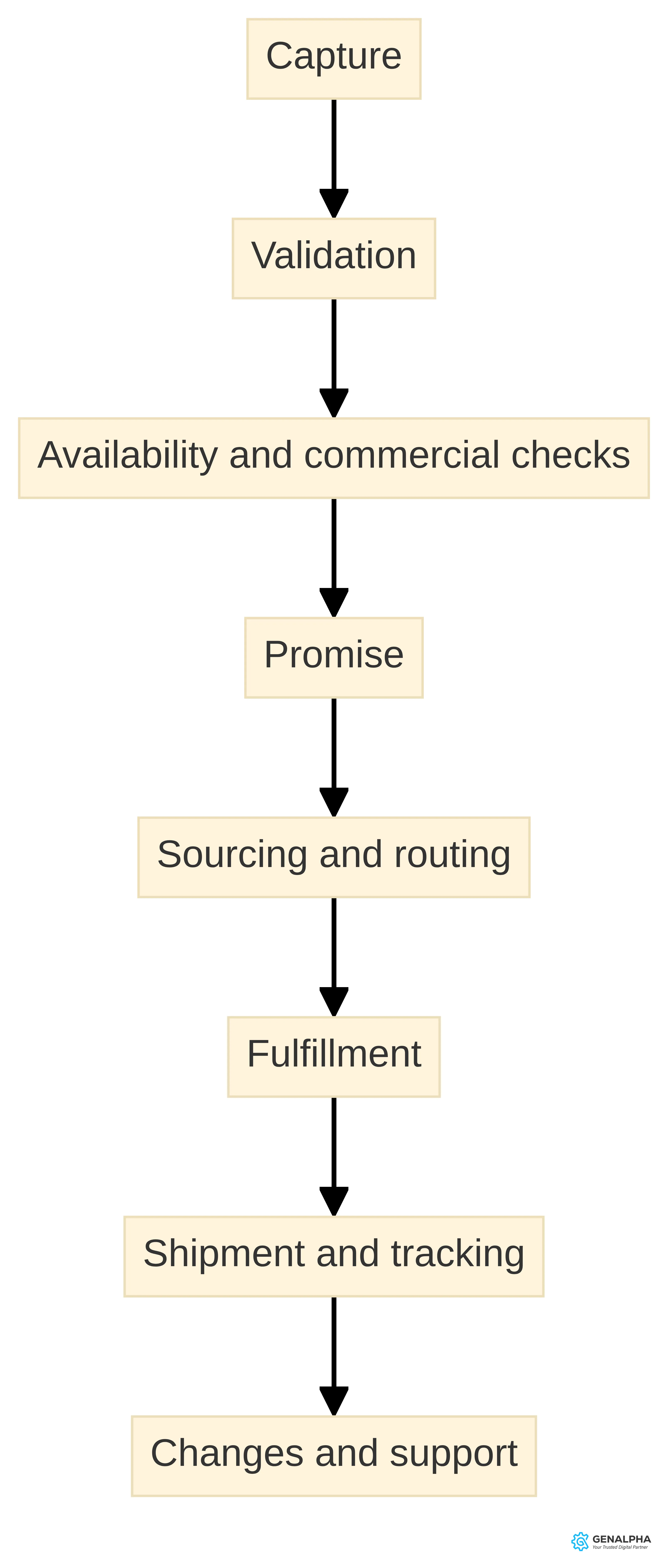
An equipment or aftermarket-parts order can move through the following sequence:
- Capture: A customer, dealer, or internal sales channel submits the order through a website, B2B portal, phone-assisted process, or another connected channel.
- Validation: The OMS receives and validates order details against required information and configured business rules.
- Availability and commercial checks: The process checks inventory availability, applies relevant pricing or discount rules, and confirms payment where applicable.
- Promise: The OMS can calculate and present a delivery or pickup promise using inventory availability and relevant supply-chain factors.
- Sourcing and routing: The system can route the order to an eligible fulfillment location using configured rules such as capacity, cost, proximity, or delivery promise.
- Fulfillment: Connected fulfillment applications receive the work, while the OMS coordinates execution and receives status updates.
- Shipment and tracking: Shipment progress can flow back to the order process so your team and customer can see the order status.
- Changes and support: Permitted changes, cancellations, returns, refunds, or exchanges can be handled through configured post-purchase workflows.
This sequence is a map for investigation. It is not a promise that every OMS performs every step without connected applications or configured rules.
A handoff is the point where one system or team passes information or responsibility to another. An OMS can act as an order hub across order capture and fulfillment applications, centralizing policies, fulfillment activity, and exceptions across connected environments. For each handoff, record the information that must move, the system that owns the next action, and the status that must return. This exposes gaps that a product demonstration can otherwise hide behind a polished order screen.
An exception is a point where the normal sequence cannot continue as planned. Examples include unavailable inventory, a split shipment, a backorder, an order change, or a return. Centralized visibility, orchestration, automation, and exception handling may address fragmented channels, inconsistent inventory data, and manual order processes, but each exception still needs a defined business rule and an accountable team. List those rules before you ask an OMS to automate them.
What those functions mean for parts and equipment orders
Parts identification is the first equipment-specific question to examine. GenAlpha describes Equip360 as built to handle complex product catalogs, including deep bill-of-materials structures and multiple configurations; that description is an example, not proof that every organization’s catalog is ready for an OMS.
Pricing and availability are the next points of friction. An OMS can show inventory availability across fulfillment sources, apply pricing or discount rules during processing, and use available supply-chain information when presenting a delivery or pickup promise. For an equipment manufacturer, evaluation should therefore include account-specific pricing, part availability, backorders, partial fulfillment, and the point at which a promise becomes visible to the customer or dealer. Ask to see the actual data path rather than accepting a generic availability label.
Order tracking connects the purchase to the support experience. OMS capabilities can include customer-facing order tracking and permitted changes, while GenAlpha states that Humphrey Service Parts aimed to provide real-time visibility into order status, shipment tracking, and invoice history through its ecommerce platform. Use that example as a workflow illustration: define which statuses your customers and dealers need, which system supplies each status, and which team handles a status that does not arrive.
Where an OMS fits beside ERP, ecommerce, CRM, and warehouse systems
An OMS is not necessarily the same system as an ERP, CRM, warehouse-management system, or ecommerce channel. A B2B description presents an OMS as a coordination layer among those systems, while an order-management hub can sit across cloud or on-premises order-capture and fulfillment applications. Use the following working distinction when you map your environment:
| System or layer | Primary responsibility to clarify | How it relates to an OMS |
|---|---|---|
| Ecommerce channel | Where a customer or dealer places or begins an order | Sends order information into the coordinated workflow |
| ERP or internal business system | Enterprise records such as customer, item, order, shipment, or invoicing details | Supplies or receives business information through an integration |
| CRM | Customer information and related customer-facing context | Connects with the OMS when customer information is needed in the order workflow |
| Warehouse or fulfillment system | Fulfillment execution at a warehouse or other location | Receives fulfillment work and returns status updates |
| OMS | Order capture, validation, sourcing, orchestration, status, and related policies | Coordinates the handoffs rather than automatically replacing every connected system |
The boundary is a design question, not a naming exercise. Write down the system of record for each data object and the system responsible for each action.
GenAlpha states that it can integrate directly with ERP or internal business systems to retrieve customer-master, item-master, sales-order, shipment, and invoicing details. GenAlpha also states that one Equip360 solution involved custom connections to Microsoft Dynamics 365, real-time synchronization for orders, inventory, and pricing, workflow adjustments, validation and testing cycles, and collaboration with internal teams and partners. Those facts illustrate why an evaluation needs an integration map: the business value depends on what information moves, when it moves, and who owns the resulting action.
The process signals that justify an OMS investigation
Your process may warrant an OMS investigation when the same order requires repeated reconciliation across channels, inventory locations, or fulfillment teams. Common signals include:
- Orders arrive through several channels but must be re-entered or manually reconciled.
- Inventory availability differs between the customer-facing channel and internal records.
- Teams cannot give a consistent status without checking several applications.
- Split shipments, backorders, or multi-warehouse sourcing require case-by-case decisions.
- Pricing, account rules, or approval steps are handled outside the order flow.
- Returns, cancellations, or order changes depend on informal handoffs.
- Manual order entry, inventory checks, or fulfillment decisions create recurring delays or errors.
These signals do not prove that an OMS is the answer. They identify a coordination problem worth mapping.
A useful test is to select one common aftermarket order and one difficult order. Record the channel, customer or dealer context, part-identification step, price source, inventory source, approval path, fulfillment location, status updates, and post-purchase action. Compare the two journeys. If the difficult order depends on manual judgment that could be expressed as a rule, an OMS may have a meaningful coordination role; if the problem comes from missing or unreliable product data, investigate that foundation first.
A single online channel does not automatically remove the need for order coordination, but it may reduce the number of handoffs an OMS must manage. Conversely, several channels do not automatically justify one. Let the number and difficulty of your order paths, rather than the number of channels alone, determine whether further investigation is sensible.
The data and integration foundation to examine
An OMS evaluation starts with a data map. Identify the records required to capture, price, fulfill, track, and support an order, then identify where each record is created, changed, and consumed. For equipment commerce, the map may include customer and account data, item and part data, configurations, pricing, inventory, order details, shipment updates, invoice details, and permitted return or change information. An OMS can connect systems and coordinate order information, but the integration design must define the fields, timing, ownership, and response when a record is incomplete.
Integration means more than sending an order from a web store to an ERP. An OMS may receive orders from external systems, validate information, coordinate fulfillment across connected applications, and report fulfillment status back to order-capture systems. We can integrate directly with ERP or internal business systems to retrieve customer, item, sales-order, shipment, and invoicing details. Ask whether each required interaction is one-way or two-way, what triggers it, and what happens when the connection or data exchange fails.
Implementation readiness also includes the work around the connection. GenAlpha states that one solution involved custom Equip360-to-D365 connections, real-time synchronization for orders, inventory, and pricing, workflow adjustments, validation and testing, and collaboration with internal teams and partners. Use those activities as a planning checklist for your own evaluation:
- Name the systems and data owners involved.
- Define the order, inventory, and pricing events that must synchronize.
- Identify workflow changes and approval points.
- Prepare test orders that include normal and exception paths.
- Assign the internal teams and external partners needed for validation.
Do not treat a connector name as a complete implementation plan.
How to evaluate exceptions, approvals, and account workflows
Exception handling is where an OMS evaluation becomes operationally useful. An OMS can centralize order policies and exception handling across connected applications, and it can support split shipments, backorders, multi-warehouse sourcing, and approval workflows. Your evaluation should show what happens when an item is unavailable, an order must be split, a customer requests a change, or a fulfillment location cannot meet the expected promise. Ask who receives the exception, what information they see, which decision they can make, and how the updated status returns to the customer-facing channel.
Approval workflows deserve a separate test because B2B orders may carry account-specific rules. An OMS can automate approval workflows, while order-processing functions may apply pricing or discount rules and confirm payment. Define the conditions that require approval, the person or team responsible, the information shown before approval, and the outcome when approval is delayed or denied. Keep the rule explicit; an informal email or spreadsheet is not a dependable substitute for a defined order state.
Account workflows should also cover the difference between a customer, dealer, service team, and internal user. A B2B OMS can connect customer information with the order workflow, while GenAlpha states that its products are highly technical and require customer interaction to assist with ordering. That combination points to a practical requirement: assess both self-service and assisted ordering. A workflow that supports a direct purchase but cannot preserve the context of a technical conversation may not fit the way your equipment buyers actually order parts.
What an OMS will not fix on its own
An OMS will not automatically correct incomplete product, customer, pricing, or inventory records. An OMS can connect and coordinate those records across an order workflow, but the organization still needs clear ownership and usable data. If customers cannot identify the correct part because supersession, configuration, or cross-reference information is missing, improving orchestration alone will not resolve that identification problem.
An OMS will not automatically replace an ERP, CRM, warehouse-management system, ecommerce channel, or logistics application. The supported B2B description presents an OMS as a coordination layer among those systems, and an order hub can operate across connected cloud or on-premises applications. Your organization still needs to decide which system owns each record, which application executes each action, and which statuses must be exchanged.
An OMS will not remove the need for business rules, workflow decisions, testing, or cross-team ownership. Manual order processes may create delays or errors, but automation only helps when the intended process is defined. GenAlpha’s described D365 project included workflow adjustments, validation and testing cycles, and collaboration with internal teams and partners. Treat those activities as part of the work, not as details to leave until after selection.
An OMS may not be the right first investigation when your main problem sits outside order coordination. If the dominant issue is inaccurate part data, unclear pricing ownership, missing fulfillment capacity, or an undefined returns policy, address that boundary before assuming an OMS will solve it. Use the order trace to identify the underlying problem and then decide whether coordination is the next necessary layer.
Equipment-commerce capabilities to investigate without assuming fit
Equipment-commerce capabilities deserve scenario-based evaluation rather than a generic checklist. For each capability, bring a real part, account, order, and exception into the discussion:
- Parts identification: Can the workflow connect the relevant equipment or configuration to the orderable part data your business uses?
- Pricing and availability: Can the process show the relevant price and availability from the systems that own those values?
- Order capture: Can customer, dealer, sales-assisted, and other supported channels enter and validate the information required for the order?
- Fulfillment coordination: Can the process route an order, support a split or backorder, and exchange status with the responsible fulfillment application?
- Customer visibility: Can the customer or dealer track the order and complete permitted changes through the available workflow?
- ERP connection: Can the system retrieve and return the customer, item, order, shipment, and invoicing details required by your process?
A capability is relevant only when it works with your data, rules, users, and connected systems.
Equip360 can serve as a concrete evaluation subject for GenAlpha’s stated scope. A solution described by GenAlpha involved real-time synchronization for orders, inventory, and pricing, along with workflow adjustments and validation. Use this project example to define questions for a configured scenario, not to assume that your catalog, ERP, or workflow will have the same fit.
Technical products also make assisted support part of the buying experience. We state that our products are highly technical and require customer interaction to assist with ordering. A relevant evaluation should therefore show how a customer or dealer moves from self-service identification to human assistance, how the order context is preserved, and how the resulting order status becomes visible after submission. Do not evaluate a parts workflow only through a simple, fully self-service order.
Questions to take into an OMS evaluation
An OMS evaluation should use your order journey as the agenda. Bring one standard aftermarket-parts order, one technically complex order, and one order with an exception. Then ask questions that expose ownership, data movement, and customer experience.
Process and fulfillment questions
- Which channels can capture an order, and how are order details validated?
- How does the workflow check availability across fulfillment sources?
- How are delivery or pickup promises calculated and presented?
- Which rules determine the fulfillment location when capacity, cost, proximity, or delivery promise differs?
- How are split shipments, backorders, cancellations, returns, refunds, and exchanges represented?
- Which system sends fulfillment status, and how does that status return to the customer-facing channel?
Ask for each answer in the context of your own order, not only as a feature description.
Data and integration questions
- Which system owns customer, item, pricing, inventory, sales-order, shipment, and invoice data?
- Can the workflow retrieve the customer-master and item-master details required for an order?
- How are superseded, obsolete, vendor, cross-reference, and legacy part numbers handled?
- Which integrations are direct, and which require custom connections or additional applications?
- What triggers synchronization for orders, inventory, pricing, and status?
- How are incomplete records, failed exchanges, duplicate orders, and delayed updates surfaced?
- What validation and testing cycles are expected before production use?
These questions turn integration language into a testable responsibility map.
Customer, dealer, and support questions
- How does a customer or dealer move from part identification to an order?
- How does the workflow support a technical conversation when self-service is not enough?
- Which order statuses, shipment details, and invoice details can the customer see?
- Who can change or cancel an order, and which approvals apply?
- How does a support team find the order context without rebuilding it from several systems?
- Which parts of the experience are configured for your account structure and fulfillment model?
Use the answers to compare the proposed workflow with the process your customers and dealers actually follow.
Fit and boundary questions
- Which specific handoffs would the OMS coordinate in your current process?
- Which problem is the evaluation intended to address: fragmented channels, inconsistent inventory data, manual work, exception handling, or another defined gap?
- Which problem remains outside the OMS, such as product-data ownership or fulfillment capacity?
- What would count as a successful test for the standard, complex, and exception orders?
A focused evaluation has a defined order journey, named data owners, explicit exception rules, and a boundary around what the OMS is expected to do.
Decide whether your order journey warrants further investigation
An OMS is relevant when your equipment or aftermarket-parts orders need a coordination layer across channels, product and pricing information, inventory sources, fulfillment applications, and post-purchase status. The decision does not depend on using every possible OMS function. It depends on whether your current journey contains recurring handoffs, disconnected data, manual decisions, or exceptions that a defined coordination process could manage.
Before moving forward, trace one standard order and one difficult order. Record the systems, data owners, approval rules, fulfillment handoffs, exception paths, and customer-facing statuses. If the exercise reveals a specific coordination gap and your organization can prepare the required data and integration questions, further investigation is justified. If the main gap is inaccurate product information or an undefined business process, resolve that boundary first.
GenAlpha can discuss how Equip360’s stated ERP connections, parts-data handling, complex catalog scope, and described D365 integration work relate to a configured equipment-commerce scenario. Bring the order trace and the questions above so the discussion stays tied to your process, not to an abstract feature list.
Practical questions before requesting an OMS demonstration
What is an order management system?
An order management system (OMS) is software that centralizes and automates the process of receiving, processing, and fulfilling customer orders across various sales channels. It integrates functions like inventory management, order tracking, and customer service into a cohesive system.
How does an OMS support equipment manufacturers?
An OMS helps equipment manufacturers by providing real-time visibility into inventory, automating order processing, and coordinating fulfillment across multiple channels.
What are the main functions of an order management system?
Key functions of an OMS include order capture and validation, inventory visibility, pricing and payment processing, fulfillment orchestration, and post-purchase service such as order tracking and returns management.
What challenges can an OMS address for equipment manufacturers?
An OMS can address challenges such as fragmented order processes, inconsistent inventory data, manual order entry errors, and difficulties in tracking order status across multiple channels.
What should equipment manufacturers consider when evaluating an OMS?
When evaluating an OMS, manufacturers should consider integration capabilities with existing systems, data visibility, exception handling processes, and how well the OMS can support their specific order workflows and customer needs.
How can an equipment manufacturer determine if they need an OMS?
Manufacturers can determine the need for an OMS by assessing their current order processes for issues like repeated manual interventions, inconsistent inventory data, and challenges in tracking orders across channels.
What limitations should be considered when implementing an OMS?
Limitations to consider include the need for accurate product and customer data, the potential complexity of integrating with existing systems, and the requirement for defined business rules and workflows to guide order processing.
What questions should be asked during an OMS evaluation?
During an OMS evaluation, questions should focus on order capture processes, data ownership, integration capabilities, exception handling, and how the system supports customer visibility and order tracking.
Sources
- Order Management Systems 2025 Guide | Streamline, Automate & Grow — www.kissingerassoc.com, 2025-08-27
- What is an Order Management System (OMS)? | Manhattan — www.manh.com, 2025-01-02
- What Is Order Management System (OMS)? Business Benefits — www.autostoresystem.com, 2023-07-06
- A guide to order management — www.sap.com
- Order Management System (OMS) for B2B e-commerce - Intershop Communications AG — www.intershop.com
- FAQs | GenAlpha Technologies
- Humphrey Customer Success Story | GenAlpha
- ERP Change Customer Success Story | GenAlpha
- Machinery Manufacturers | GenAlpha