
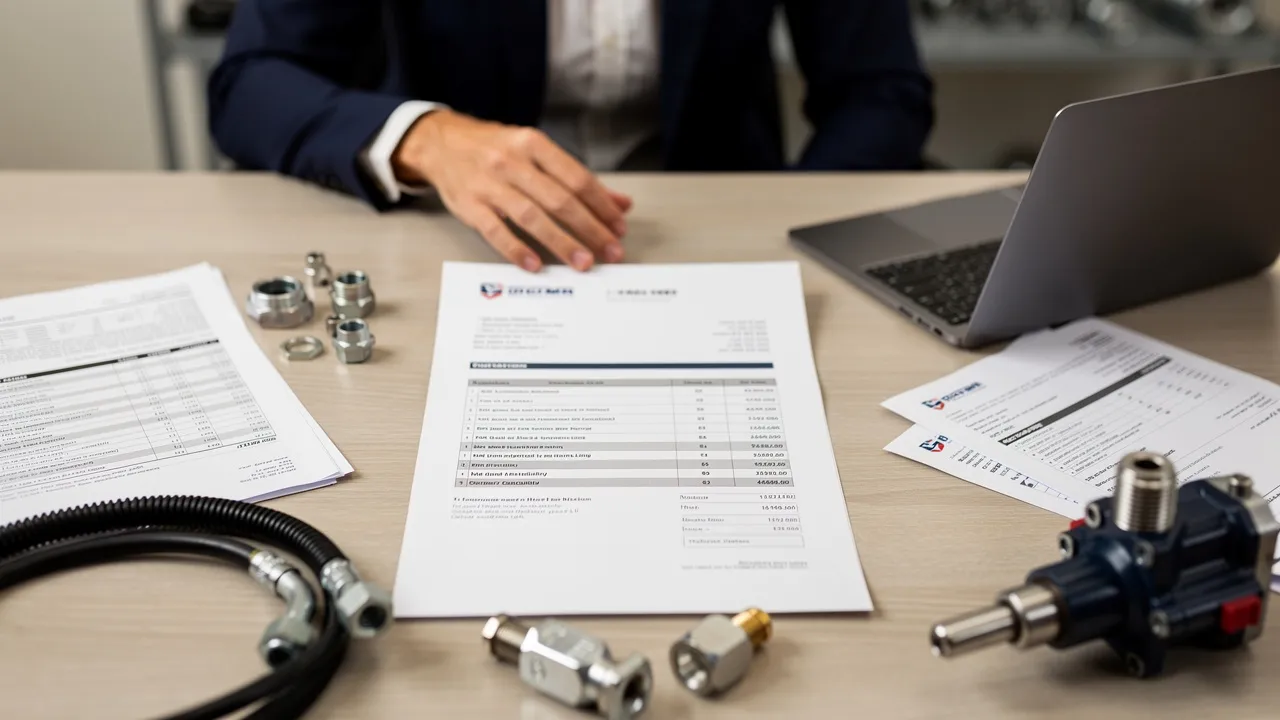
Start with the quotation’s role in a parts purchase
A business quotation is the seller’s pricing or offer document for specified goods or services. In an equipment or aftermarket-parts purchase, it gives you a defined basis for asking what is included, how much it costs, when the terms apply, and what happens if you decide to proceed. A useful quotation is more than a number in an email; it connects the requested item to its scope, price, commercial conditions, and next action.
A purchase order has a different role. The quotation comes from the seller, while the purchase order comes from you or your buying organization to formalize the intended purchase under stated terms. Keeping those roles separate helps you review the offer before your organization commits to an order.
Imagine that you need replacement components for a specialty vehicle, or that your dealership is preparing an equipment order for a regional customer. The first question is not simply whether the total appears affordable. You also need to know whether the quotation covers the correct configuration, quantity, delivery expectation, options, and conditions.
Use this guide to move from a vague price request to a focused review. By the end, you should be able to identify what needs to be stated, what needs clarification, and when a purchase order is ready to reflect the agreement.
Separate the quotation from the documents around it
A quotation presents the seller’s pricing or offer, while a purchase order formalizes the buyer’s intention to purchase specific goods or services under stated terms. The quotation helps you evaluate what is being offered. The purchase order communicates what your organization is asking the seller to accept.
A proposal may cover a broader vision and approach, whereas a quotation focuses on scope, pricing, and terms. That distinction matters when you are buying parts or equipment: a proposal may explain a wider project, but the quotation should give you a workable commercial description of the items or services being considered.
Estimates, quotations, and proposals are treated as distinct concepts in business negotiations, so do not assume that similar labels carry the same meaning in every transaction. Ask the seller what the document is intended to do and which terms apply. A contract should not be treated as interchangeable with a quotation; confirm its role and applicable terms before relying on it.
An invoice belongs at a later checking point in the purchasing sequence: the selected process describes comparing the invoice with the purchase order and delivery receipt to identify discrepancies. A purchase order, by contrast, is prepared before receipt and payment. For any document that uses a different label, ask whether it is preliminary pricing, a request for payment, or the terms governing the transaction before you rely on it.
A practical sequence looks like this:
- Define the goods or services, quantity, timing, and estimated budget.
- Request and compare quotations.
- Agree the terms that need to be settled.
- Prepare and approve a purchase order.
- Obtain supplier confirmation.
- Check the delivered quantity and quality.
- Compare the invoice with the purchase order and delivery record.
- Complete payment according to the agreed conditions.
The sequence keeps pricing review, ordering, delivery checking, and payment checking connected without treating the documents as interchangeable.

Read the quotation as a defined offer, not a vague price
A quotation should make the offered goods or services, scope, pricing, and terms clear enough for you to decide whether to proceed. A quotation can be a fixed-price document covering specified goods or services, but that description does not make every commercial detail automatic. You still need to inspect what the price covers and what it leaves outside the quoted scope.
For equipment and aftermarket parts, scope may include the particular item requested, the quantity, the selected configuration, and any accessories or services attached to the order. If the quotation uses a broad description such as “replacement parts” or “equipment package,” ask for the details that determine whether the offer matches your request.
Read the quotation in four passes:
- What is being offered? Identify each good or service and the intended application.
- What is included? Separate the base item from accessories, services, options, and exclusions.
- What does the price cover? Look for line items, totals, taxes or other stated charges, and conditions attached to the amount.
- What must happen next? Find the validity period, acceptance route, required information, and expected confirmation.
A clear scope makes comparison possible. If two sellers describe different configurations or include different accessories, comparing only the total price can give you the wrong conclusion.
Check identity, dates, and validity
A quotation should identify the seller clearly enough for you to know whose offer you are reviewing and whom to contact with questions. Australian business-quote guidance gives one jurisdiction-specific example: it lists the legal entity and trading name, address, Australian business number, contact details, and website as business details to include. Treat those fields as an example of useful identification, not as a universal checklist for every country or transaction.
For your own review, record the seller’s legal or trading name, the contact person, and the contact route shown on the document. Match those details with the supplier you intended to approach. Put your own business name, delivery details, and purchasing contact in the request so the seller can identify the account and transaction correctly.
The quotation date, reference number, and expiry date help you identify which version you are reviewing and how long the quoted conditions are intended to apply. Australian guidance specifically recommends those fields and notes that material costs and supplies can increase quickly. The jurisdiction and commercial context matter, so do not treat that guidance as a blanket rule for every quotation.
Check these details before comparing offers:
- Is the quotation dated?
- Does it have a unique reference or quote number?
- Is there an expiry date or another validity condition?
- Does the stated period cover your expected approval and ordering time?
- Will the seller reissue the quotation if the period passes?
A price that has expired should not be treated as the same offer without clarification. Ask which price, availability, and terms apply before you prepare an order.

Verify the parts or equipment line by line
A line-by-line review connects the quotation to the physical equipment or part you intend to buy. A quotation can show a line-item cost breakdown and total cost while clearly identifying the specified goods or services and their scope. Use those principles to test whether the document describes the purchase precisely enough for your team to approve it.
For each line, compare the quotation with your request:
- Part number, model, or other identifying reference, where applicable
- Plain-language description of the item
- Equipment model, configuration, or application that affects fit
- Quantity and unit of measure
- Unit price and extended line total
- Freight, handling, installation, or other stated charges
- Tax component or tax treatment shown on the quotation
- Total amount and currency
Do not fill in a missing detail from memory. Ask the seller to add or correct it.
Options and omissions deserve the same attention as the base item. A quotation can identify variations, revisions, accessories, services, options, and add-ons that are not included in the base quote. That makes the boundary of the price easier to understand, but you still need to ask whether a required component is absent.
For example, a replacement assembly may require an accessory, service, or revision that is not part of the base line. A complete equipment package may be shown without an optional attachment that your customer expects. Mark every item as included, excluded, optional, or still to be confirmed. Then ask for a revised quotation if the selected configuration changes the total.
Ask what the price assumes
A quoted price rests on conditions, and those conditions may affect whether the offer works for your customer, warehouse, service team, or delivery schedule. The quotation should make the scope, pricing, and terms clear, while options, add-ons, payment timing, and validity may need separate attention.
Ask focused questions rather than sending a general request to “confirm everything.” For an equipment or aftermarket-parts purchase, ask:
- Is the requested item available, allocated, or subject to confirmation?
- What delivery date or delivery window does the price assume?
- Is the price valid until a stated date, or can it change before acceptance?
- Are freight, handling, installation, or other charges included?
- Which accessories, revisions, or services are excluded?
- What payment methods are accepted, and when is payment due?
- What warranty terms apply to this item or service?
- What return, cancellation, or restocking conditions apply?
- What information does the seller need before confirming the order?
- What event counts as acceptance, and what confirmation will follow?
Payment deserves a direct question because a quote can state accepted payment methods and when payment is due. Examples include lump-sum payment, periodic payments, and half up-front with the balance on completion; these examples do not establish which arrangement applies to your purchase.
Write the answer beside the quoted total. Note the payment method, due date or stage, deposit if any, currency, and any condition that could change the amount. Keep payment questions separate from warranty and returns questions: they may appear in the same terms, but they answer different purchasing concerns.
Availability, delivery, warranty, returns, and next steps are practical clarification topics, not assumptions you should silently add to the quotation. If the document does not answer one of them, record the question and wait for a clear response before treating the quote as ready for approval.
Follow a simple request-and-review sequence
A purchasing process can begin with a defined need and continue through quote comparison, agreed terms, purchase-order approval, supplier confirmation, delivery checking, invoice verification, and payment. You can use that sequence to organize a parts or equipment request without treating the quotation as the entire transaction.
Start by writing down the information that will shape the offer:
- Need: Describe the equipment, part, service, application, or replacement purpose.
- Quantity: State the number of units and any different configurations.
- Timing: Give the required delivery window or operational deadline.
- Budget: Provide an internal budget or approval boundary when appropriate.
- Commercial questions: List the conditions that must be answered, such as delivery, payment, warranty, and returns.
A precise request gives the seller something specific to quote and gives you a reference for checking the reply.
When the quotation arrives, compare it with the request rather than reading the total first. Check the item identity, quantity, options, line prices, total, dates, validity, payment conditions, and delivery information. Highlight each difference and ask whether it is intentional, required, excluded, or an error.
After clarification, compare quotations on equivalent scope. If one offer includes an accessory, service, or delivery charge that another leaves out, make that difference visible before you discuss price. Agree the unresolved terms, then send the quotation and clarifications through your internal approval route.
The purchase order comes after the review and approval stage. Prepare it to reflect the approved goods, quantities, prices, delivery instructions, payment terms, and other agreed details. Obtain supplier confirmation, then check the delivered quantity and quality against the order. When the invoice arrives, compare it with the purchase order and delivery record before payment.
This sequence gives each document a practical job: the quotation supports evaluation, the purchase order communicates the intended purchase, delivery records support receipt checking, and the invoice is checked against what was ordered and received.
Clarify acceptance before issuing a purchase order
A purchase order formalizes your intention to purchase under stated terms; it does not automatically tell you how the seller will treat acceptance. That wording makes the acceptance route a question to settle before you assume the order is complete.
Ask the seller:
- Does issuing the purchase order accept the quotation?
- Is another written acceptance or confirmation required?
- Which quotation version and terms should the purchase order reference?
- Does the seller accept the purchase order terms, or do the seller’s terms govern?
- When will the seller confirm price, availability, and delivery?
Your purchase order can identify the parties and specify the items, quantities, agreed prices, delivery instructions, and payment terms. Use the approved quotation as the comparison point and make sure the order reflects the same scope. If the order changes the quantity, configuration, delivery location, or commercial terms, flag the change instead of assuming the quotation remains unchanged.
Some seller terms allow acceptance through a purchase order or another accepted writing, while different or additional buyer terms require the seller’s written and signed agreement. This is an example of transaction-specific wording, not a universal rule for every seller. If your purchase order contains conditions that differ from the quotation, ask which terms are accepted and obtain the required written response before proceeding.
Keep the accepted quotation, clarifications, purchase order, and supplier confirmation together. That record makes it easier to identify the version and terms your team intended to use.
Use a three-stage quotation checklist
A three-stage checklist turns quotation review into a repeatable conversation: prepare before requesting the quote, inspect the document when it arrives, and resolve the final questions before issuing a purchase order. The checklist does not replace the seller’s terms. It gives you a practical way to notice gaps before they become ordering problems.
Before requesting a quotation
Prepare these details:
- The equipment, part, or service you need
- Part number, model, configuration, or application information where relevant
- Quantity, unit of measure, and required delivery timing
- Delivery location and receiving constraints
- Options, accessories, revisions, or services you may need
- Internal budget or approval boundary
- Questions about availability, warranty, returns, payment, and next steps
- Your purchasing contact and the date by which you need a response
A defined request makes it easier to compare the eventual quotation with the original need. It also gives the seller a clear opportunity to identify information that is missing.
While reviewing the quotation
Check the document in this order:
- Seller identity and contact details
- Quotation date, number, and validity or expiry date
- Item descriptions, quantities, configurations, and options
- Line-item prices, additional charges, taxes, and total
- Availability and delivery timing
- Included services and excluded accessories or add-ons
- Payment method, payment timing, warranty, and returns
- Acceptance route and the seller’s stated terms
Mark each point as clear, different from your request, or unanswered. A line-item breakdown and clearly stated options can help you see whether the quoted total covers the purchase you actually need.
Before issuing a purchase order
Confirm that:
- The item identity and quantity match the approved request.
- The quoted price and total match the version you intend to use.
- Availability and delivery expectations are stated clearly.
- Options, accessories, services, and exclusions are understood.
- Payment, warranty, and returns questions have answers.
- The quotation is still valid, or the seller has provided an updated version.
- The purchase order will identify the parties, items, quantities, prices, delivery instructions, and payment terms.
- The seller has explained how acceptance and confirmation will occur.
If one answer remains unclear, pause the order and send a focused question. A short clarification is easier to manage than an unrecorded assumption.

Treat seller terms and changes as transaction-specific
Changes after acceptance may also have consequences under the applicable seller terms. Some seller terms require prior written consent to cancel or modify an accepted purchase order and reserve the right to revise price and delivery schedules after requested changes. That is an example of a seller’s stated condition, not a universal rule.
Before changing an accepted order, ask for written confirmation of:
- Whether the change is accepted
- Any revised price or delivery schedule
- Whether availability or configuration has changed
- Which quotation, order, and terms now govern
- Whether the seller needs a revised purchase order
Keep the boundary clear: a quotation can support a decision, but the actual effect of acceptance, modification, cancellation, or conflicting terms depends on the transaction documents and applicable conditions.
End with a proceed-or-clarify decision
Proceed with a purchase order when the item identity, quantity, scope, price, availability, delivery expectation, validity period, commercial conditions, acceptance route, and next step are clear. If any of those points remains unresolved, send the seller a short list of questions and wait for the quotation or terms to be clarified before ordering.
Use the quotation to compare the offer, use the purchase order to state the intended purchase, and use supplier confirmation, delivery records, and invoice review to keep the transaction aligned. For questions about legal, tax, accounting, or individualized commercial consequences, consult a qualified professional who can assess your transaction and applicable rules.
When your quotation questions are defined, you can assess how a dealer or aftermarket-parts purchasing workflow would support the handoffs your team needs.
Questions to resolve before accepting a quotation
What should you do if a business quotation has expired?
Do not assume the expired price, availability, or terms still apply. Ask the seller to confirm whether the quotation can still be accepted or request an updated version, then compare the revised details with your original request before issuing a purchase order.
How can a dealer compare two quotations for the same parts or equipment?
Compare equivalent scope rather than totals alone. Check the item identity, configuration, quantity, included accessories or services, additional charges, delivery expectations, payment terms, warranty, returns, validity period, and acceptance conditions. Record exclusions and unanswered points so differences are not mistaken for price advantages.
What should you do when a purchase order differs from the quotation?
Identify every difference in quantity, configuration, price, delivery, payment, or other terms before sending the order. Ask the seller which terms are accepted and obtain written confirmation or a revised quotation where needed. Keep the approved quotation, clarifications, purchase order, and supplier confirmation together.
Does accepting a business quotation always create the same obligation?
No single acceptance route applies to every transaction. Some seller terms describe a quotation as an offer that depends on the buyer’s acceptance and the seller’s confirmation of the purchase order; other terms specify acceptance through a purchase order or another accepted writing. Read the applicable terms and clarify how acceptance, conflicting conditions, changes, and cancellation are handled before proceeding.